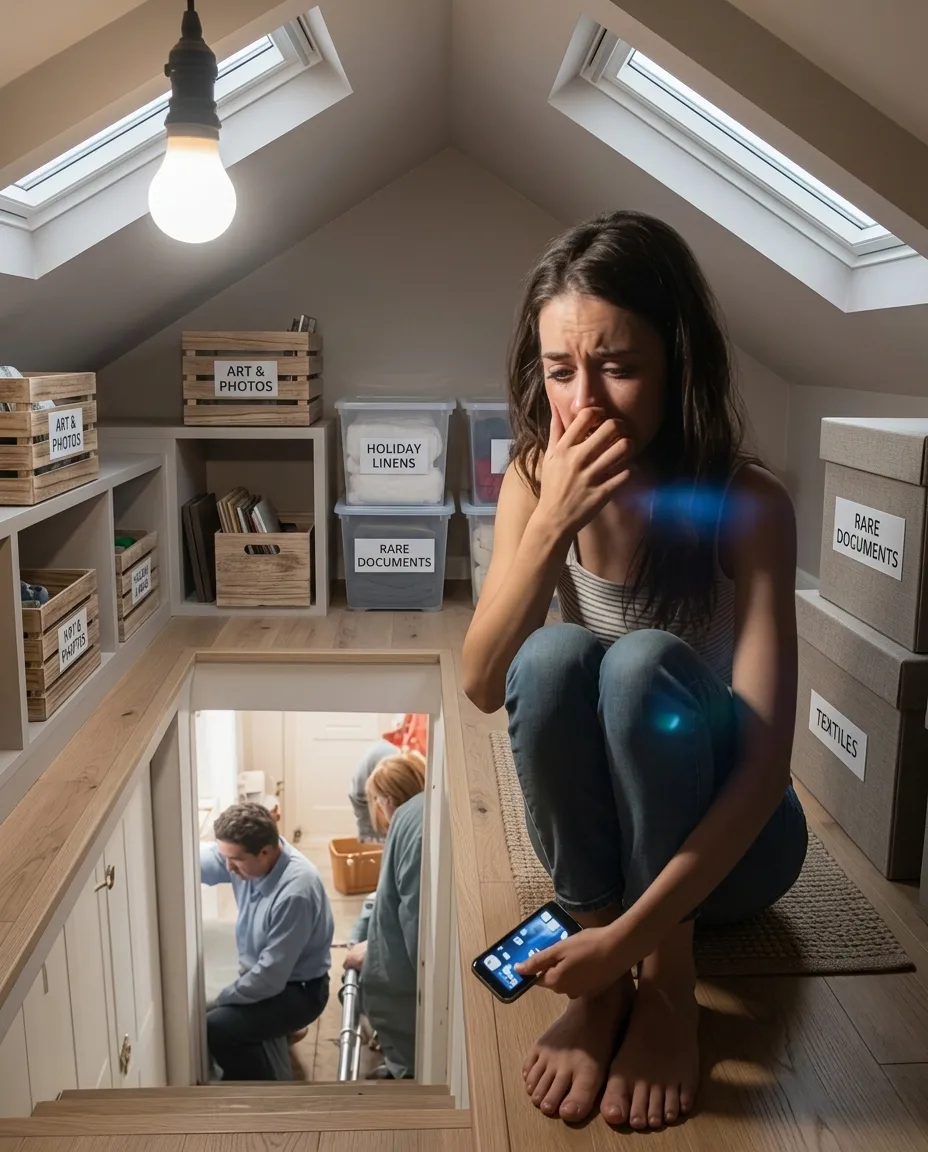
Mara came up the attic stairs herself. She knocked twice and said my name, and when she heard me moving toward the door she said, “It’s me,” and I opened it and she was standing there in her field jacket, rain still in her hair, and she grabbed me before I could fall. They told me everything in a conference room at the field office that smelled like industrial cleaning solution and burnt coffee.
I sat wrapped in a gray blanket someone had produced, holding a cup I never drank from. Mara sat across the table and a colleague of hers named Desmond sat to her left, and they went through it methodically, the way you explain something complicated to someone who is in shock, which is to say slowly and with repetition. My husband’s real name was Owen Price.
He had been under investigation for over two years for laundering money through a network of small logistics companies. The scheme involved stolen medical equipment and falsified export documentation, transactions routed through shell companies in three countries. My laptop, the one I used for client bookkeeping, had been used to move files and authorize accounts in my name.
My credentials. My digital signature. Access I had freely given him because we shared a home and he had told me he occasionally used my machine when his was charging, and I had not thought to question it because I was his wife and we did not keep secrets from each other.
I was not a co-conspirator. I was a clean identity, maintained carefully over years, worth more to him intact and unsuspecting than compromised. “How long have you been watching him?” I asked.
“Twenty-two months,” Mara said. She held my eyes when she said it, and I understood without her saying it explicitly that she had known for twenty-two months and had not told me. “We couldn’t tell you.
He was monitoring your communications. Any change in your behavior could have triggered the exit plan early.”
“He was monitoring my communications.”
“His phone had software on it that could access your texts and email. We found it during the investigation.”
I thought about all the texts I had sent Mara over those months.
Making plans for Sunday dinners. Complaining about Noah’s sleep schedule. Complaining about Caleb working late.
Had Owen read those and felt something, some awareness that the surveillance was mutual, that his wife’s FBI agent sister was closer to him than he knew? Had he felt secure anyway, because I was not Mara, because I was the ordinary one, the bookkeeper with the freelance clients and the baby monitor and the cheerful ordinary life? She chose well.
That was what the stranger had said, and Caleb had not smiled when he heard it. That wasn’t part of the plan. I understood that now, in the way you understand things in retrospect that your body had always partially known.
Six years of marriage had not been a lie exactly. It had been something more complicated than a lie. A life that served a purpose, constructed with genuine care for its own maintenance, perhaps with something that resembled feeling in certain moments, but purpose always at its center.
When Noah was born, that had been an unexpected variable. The kid complicates things. Our son.
Our four-year-old son who had spent the night in a car with people he believed were his grandparents, being driven north toward a crossing point where three passports with wrong names would begin a new chapter of a story I would never have known the shape of. Noah was brought to me at 6:40 in the morning. The sky outside the field office windows was turning from black to gray, that pre-dawn color that looks like the world before it has committed to the day.
He came in wearing his dinosaur pajamas and carrying a stuffed fox I had never seen before, clutching it with the focused grip of a child who has been given something in a confusing moment and has decided to hold onto it. Mara had bought it for him at a gas station. He looked at me with the slightly betrayed expression of a four-year-old who has been moved around in the middle of the night without adequate explanation, and then he registered my face and whatever he saw there made him cross the room immediately.
“Mommy, too squishy,” he said into my neck, because I was holding him so tightly he was compressed, and I laughed in the way that comes out when laughing and crying reach the same exit at the same time and what emerges is neither, is something rawer than both. I held him and I looked at Mara over the top of his head and she looked back at me with the expression she had worn through every difficult thing we had been through since childhood, steady and tired and refusing to be otherwise. “Thank you,” I said.
She shook her head once, like it was not something to be thanked for. Like it had only ever been what sisters do. The case took more than a year to fully resolve.
Owen pleaded guilty to conspiracy, identity fraud, money laundering, and custodial interference. The man in the raincoat was Victor Hale, a former associate of Owen’s real father who had served time in federal prison, and who had apparently taken Owen in afterward and guided him into the work that eventually brought the FBI to my hallway. Victor received a longer sentence for coordinating the escape plan and for his role in moving Noah.
The people who had posed as Caleb’s parents for six years were charged separately. I had known them as gentle, warm people who kept peppermints in a bowl on the kitchen counter and had a dog named Gravy who was frightened of the vacuum cleaner. I had trusted Noah with them without hesitation.
I had sent them Christmas cards. I had sat across from them at holiday dinners and eaten food they cooked and believed every word of every story they told. I was cleared after investigators established that all unauthorized access to my accounts had occurred without my knowledge.
That determination was necessary and correct and did not make things substantially easier. The distinction between being deceived and being culpable matters legally and does not resolve the ordinary daily consequences of having been the instrument of something terrible without knowing it. For months I checked every door lock three times before I could sleep.
The sound of a phone ringing after dark sent a physical shock through me before I could intercept it with my conscious mind. I drove Noah to his preschool along routes I had memorized from alternate directions, not for any practical reason, just because the familiar route felt exposed in a way I could not fully articulate. Noah asked about his father with the frank persistence of a child who has not yet learned that some questions are not asked because the answers are too large to hold.
Why couldn’t Daddy come home. When would Daddy come home. Was Daddy sick.
I sat with him through each iteration of the question and found different ways to tell him the truth in increments appropriate to a four-year-old, and none of them were adequate, and I told them anyway because the alternative was to give him the same thing his father had given me, which was a story that felt true until it came apart. Mara stayed for six weeks. She slept on my couch and made pancakes that were uneven and slightly undercooked in a way she remained baffled by regardless of how many times she made them, and she sat with me through the nights when I could not sleep and the mornings when getting out of bed required more than I had and every ordinary moment that had become strange now that I knew what had been living inside the ordinary.
She reminded me, more than once, that I was alive because I had listened. I think about that. I had not been brave in any dramatic sense.
I had not acted on suspicion or followed some careful investigative instinct. I had answered a phone call at midnight and obeyed my sister’s voice when it told me to move without asking why. My safety had been downstream of Mara’s eleven years of work and the FBI’s two-year investigation and the intercepted car on the highway.
My contribution had been compliance and a locked attic door. And yet. And yet I had gotten out of bed and gone up those stairs in the dark.