I had not called Caleb’s name to reassure myself. I had not told myself I was overreacting and gone back to sleep. Something in me had heard Mara’s voice and recognized it as the register she reserved for real things, and I had moved.
I did not know who Owen Price was. I did not see him clearly through six years of proximity and ordinary life and love that I experienced as real even if it served a purpose I was not aware of. The wedding photographs were not lies.
The packed school lunches were not performances in any simple sense. He had been present with Noah in ways that required genuine attention, reading the same board book forty-seven times in a row with the same patience, teaching him to kick a soccer ball on Saturday mornings in the backyard. But the man I believed I knew was a version of a person constructed with the specific purpose of appearing trustworthy, and I had been chosen for the life we shared because I was stable and organized and unlikely to look closely at anything that did not present itself as requiring attention.
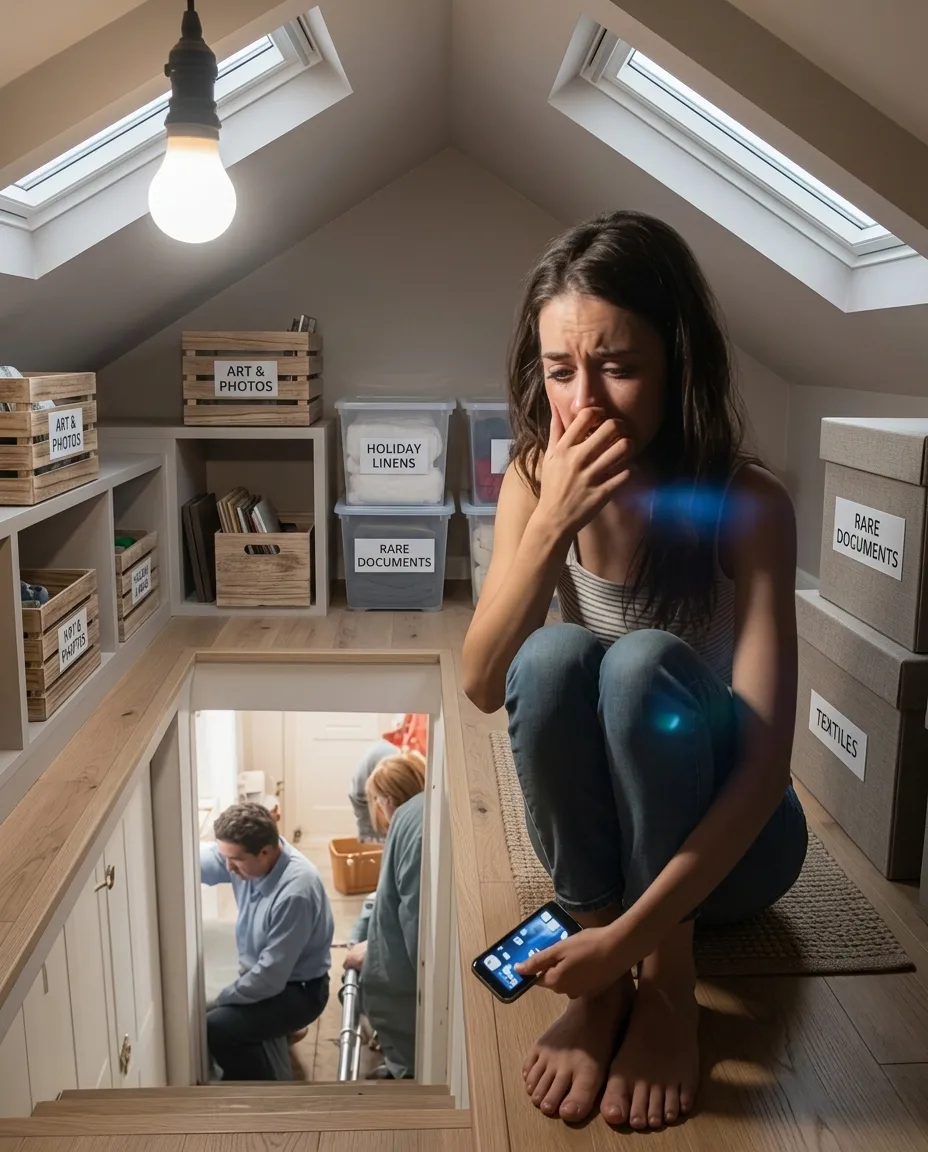
That’s what frightens me most. Not the dramatic revelation of the attic, not the handcuffs and the passports and the stranger in the raincoat. The fact that I did not see it, and that my not seeing it was part of the design, and that there was nothing I could have noticed that I failed to notice.
He had been careful enough that there was nothing to find. Noah and I moved to a smaller house in Richmond eight months after that night. I went back to my maiden name, Elise Harper, on everything.
Noah is Harper too now, and when he is old enough I will explain why, and I will tell him as much of the truth as he can hold, and I will let him ask the questions he needs to ask. The house in Richmond has no attic. I chose that deliberately, though I am aware it is not a rational criterion for selecting a home.
I live on one level now, all rooms visible from the central hallway, nothing hidden above. It is a practical house on a quiet street and Noah has made friends with a boy two doors down and they run between the two yards with the unconscious freedom of children who understand that they are safe. Mara comes for Sunday dinners when she can make it, which is not as often as either of us would like.
She still makes terrible pancakes when she stays over, and she is still baffled by this, and Noah finds it very funny and has appointed himself the official pancake corrector, which means he stands beside her at the stove offering suggestions she does not follow. It is ordinary and small and it is the best thing I know how to describe about the life I have now. Sometimes, in the way of things you did not ask to carry, I think about Owen in the hallway at the bottom of the attic stairs, looking up into the dark and knowing I was there, saying those last words to me in the moment before everything ended.
Your sister should have stayed out of this. There was no emotion in it that I could identify as anger or regret. Just a statement, like the final update in a set of calculations.
I think about it and I do not have a clean feeling about it. I have several feelings at once, which is the condition of surviving something complicated, that you cannot resolve it into a single clear emotion and you stop expecting to. What I know is simpler than any of the rest of it.
My sister called. I answered. I went up the stairs.
We came out under our real names. Noah is asleep two rooms away as I write this. The monitor on my desk glows its steady green.
The rain tonight sounds exactly like the rain on the night everything happened, which is simply because it is the same kind of rain, ordinary October rain, and not because the world is arranging symbols for me to interpret. The lock on the front door is a deadbolt I installed myself three weeks after we moved in. I check it once before bed, which is progress from three times, and I expect that eventually I will check it not at all, or only occasionally, the way you check things that do not require checking but that habit and care make you verify anyway.
I am learning to live in a house where I trust the rooms. That is the work now. It is slow and it is not linear and some days it does not feel like work so much as just existing inside what happened, sitting with the knowledge of it until it becomes part of the ordinary weight of being a person who has lived a life.
But Noah laughed today until he got the hiccups, which he finds additionally funny, which extends the laughing until the hiccups resolve themselves, which is a whole cycle that took about four minutes and which I watched from the kitchen doorway with everything I had. That is what we have. That is what we kept.