He and I talked once, formally, in Rachel’s office. He looked smaller than he ever had. The anger was gone. In its place was the horror of a man who had let the wrong person narrate his life until a hospital room made him read the actual text.
“I’m sorry,” he said.
“I didn’t see it.”
“You didn’t want to see it.”
He had no answer for that.
Emma and I moved to my sister’s house while the legal process continued. Emma had nightmares for weeks. She would wake up asking if Grandma could find us there. I would hold her in the dark and say no, she couldn’t.
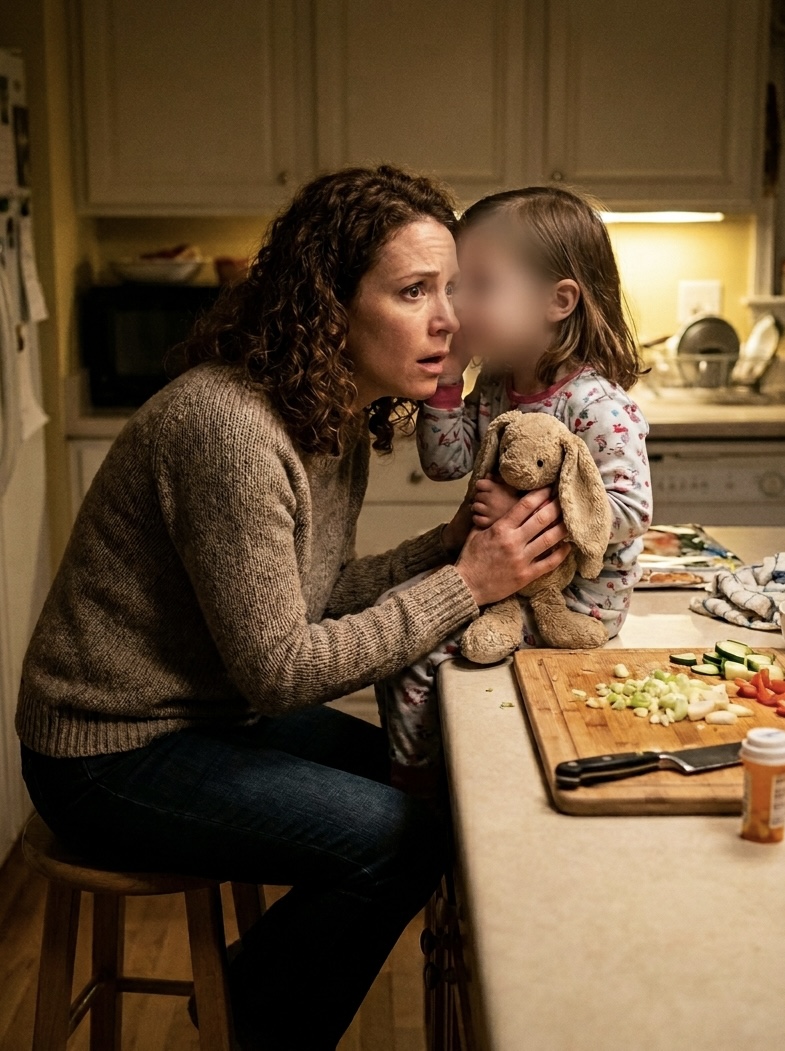
Emma’s therapist, a small woman named Dr. Reyes who had a bowl of smooth stones on her desk, told me Emma had been managing an impossible situation for weeks. “Four-year-olds are not equipped to carry adult secrets,” she said. “She carried it the only way she could: by not swallowing the pill one day, keeping it, and asking you when she felt safe.”
She kept it. She waited. She asked me when she felt safe.
My daughter had protected herself the only way she knew how.
Six months later, Emma asked to visit her father. I said yes, with conditions. Supervised visits at first. Gradual.
She came back with a drawing she had made at his apartment. A house. A large figure and a small figure outside it. The large figure had a yellow circle for a face.
“Who is this?” I asked.
“That’s Daddy,” she said. “He has a sad face because he knows he did a bad thing.”
She pointed to the small figure.
“And this is me. My face is happy because I’m with you.”
I kept the drawing.
Not as proof of anything. Not as a record. Just as a picture of where we were. Two figures outside a house. The small one, happy. The large one, learning.
It was not everything. It was enough for that day.