
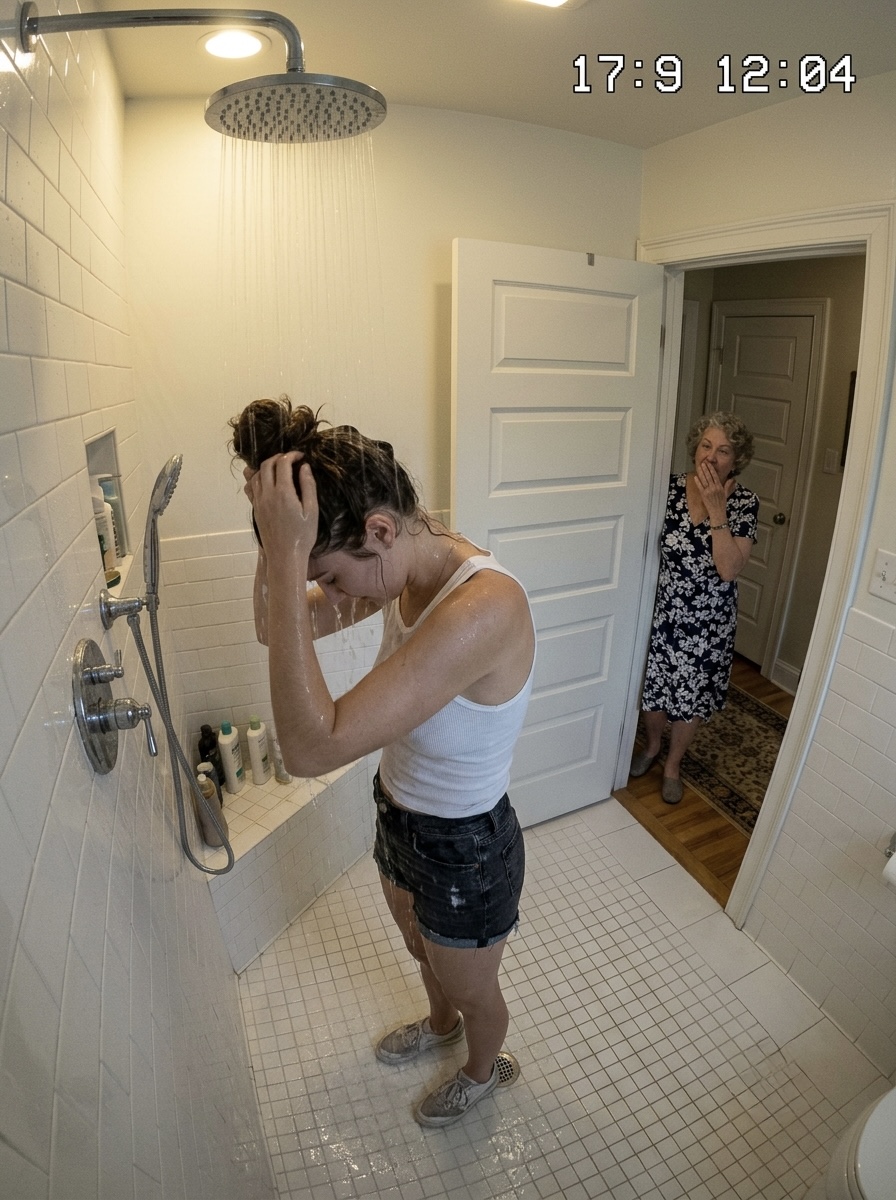
I stepped away from the door on trembling legs, my mind racing with the implications of what I had overheard. A stranger was in our home, hidden in our bathroom, while my son worked tirelessly to support his new family.
The betrayal felt like a physical wound.
Without stopping to consider the consequences, I grabbed my purse and house keys and hurried to the nearest police station. The duty officer, a middle-aged man with a kind face and tired eyes, listened to my breathless explanation with professional attention.
“Madam, you’re saying there’s an intruder hiding in your bathroom right now?”
“Yes, yes! I heard him talking.
My daughter-in-law is in there with him. Please, you must come immediately.”
Within fifteen minutes, two constables and a senior officer arrived at our building. I led them up the stairs to our third-floor apartment, my heart pounding so loudly I was certain the entire building could hear it.
The bathroom door was still closed, water still running intermittently.
The senior officer knocked firmly on the door. “Police! Open the door immediately!”
The water stopped abruptly.
Several seconds of silence followed, then Priya’s voice, high-pitched with surprise and fear: “Yes? What’s happening?”
“Open this door right now, madam.”
When the door opened, Priya stood there in a bathrobe, her hair damp and her face pale with shock. Behind her, the bathroom appeared empty—just white tiles, familiar fixtures, and the lingering scent of that mysterious masculine fragrance.
One of the constables pushed past her and began a thorough search of the small space.
He checked behind the door, inside the shower stall, and even opened the small window that led to an air shaft. Nothing. No one was there.
But then the senior officer called out from near the sink: “Two toothbrushes here.
And two deodorants—one for men, one for women.”
Priya’s face crumpled. She began to shake, her hands clutching the edges of her bathrobe as if it were the only thing keeping her upright.
“Miss, you’ll need to come to the station with us for questioning,” the officer said gently but firmly.
The ride to the police station was conducted in heavy silence. Priya sat beside me in the back seat of the police vehicle, staring out the window with the expression of someone watching her life fall apart in real time.
I felt a complex mixture of vindication and sorrow—I had been right to be suspicious, but taking pleasure in being right felt petty and cruel.
At the station, after the paperwork was completed and Priya’s identity was verified, she finally spoke. Her voice was steady despite the tears streaming down her face.
“Please, I need to tell you the truth. But I beg all of you—especially you, Maaji—to listen to the complete story before you judge me.”
The room fell silent.
Even the constables, who dealt with domestic disputes regularly, seemed to sense that this was not a typical case of marital infidelity.
Priya began with a single name: “Arjun.”
The story that emerged over the next hour was more complex and heartbreaking than any of the scenarios I had imagined. Arjun was Priya’s younger brother, but their relationship had been shrouded in secrecy and shame for most of their lives.
Twenty-one years earlier, Priya’s mother, Lakshmi, had worked as a domestic helper for a wealthy family in Ooty. Priya was four years old at the time, and they lived in a small room provided by her mother’s employers.
Lakshmi was a widow who had been struggling to support her daughter on the meager wages of domestic work when she became involved in an affair with her male employer.
When Lakshmi became pregnant with Arjun, the scandal destroyed their lives completely. The employer’s wife discovered the affair and immediately dismissed Lakshmi, refusing to provide any support for the child or acknowledge the father’s responsibility. Lakshmi was forced to return to her ancestral village in rural Maharashtra, where she and her children faced constant social ostracism.
Arjun grew up without a father’s name on any legal documents, making it nearly impossible for him to access education or formal employment.
He learned to repair refrigerators and air conditioning units through informal apprenticeships, but his lack of official credentials limited his earning potential and trapped him in a cycle of economic instability.
“Two months ago, just after my wedding, Arjun called me in desperation,” Priya continued, her voice breaking with emotion. “He had borrowed money from local moneylenders to buy tools and equipment for his repair business. But the interest rates were impossible—they were charging him forty percent per month.
When he couldn’t pay, they threatened to hurt him.”
Arjun had fled to Mumbai, hoping to find work and escape his creditors. But without proper documentation or local connections, he couldn’t rent a room or find legitimate employment. The informal networks that might have helped him required guarantees and references that he couldn’t provide.
“He slept on the street for three nights before he called me,” Priya said.
“He was my only remaining family—my mother died two years ago, and I had no other siblings. I couldn’t abandon him.”
So she had made the impossible decision to hide Arjun in their home without telling her new husband or mother-in-law. Every evening after I went to bed, she would let him into the apartment through the back entrance that led to the kitchen.
He would hide in the bathroom—not to bathe, but simply to have a safe place to sleep for a few hours.
The running water was meant to mask any sounds he might make while cleaning himself with wet wipes or speaking quietly on the phone to contacts who might help him find work. The masculine deodorant and extra toothbrush were attempts to help him maintain basic hygiene and dignity while living in hiding.
“I know I was wrong not to tell you, Maaji,” Priya said, looking directly at me. “But I was terrified that you would think the worst of me.
I was afraid that if you knew about my family’s shame—about Arjun’s birth, about the scandal—you would ask Rohan to divorce me.”
The camera had been blocked because Arjun noticed the small red light and covered it with a towel, fearing that they were under surveillance for reasons he couldn’t understand. The voice I had heard was Arjun speaking to a former employer, trying to convince him to provide a character reference that might help him find legitimate work.
As Priya’s story unfolded, I felt my anger transforming into something more complex—a mixture of sympathy, understanding, and profound guilt for the assumptions I had made. This young woman, barely three months into her marriage, had been carrying an impossible burden alone, trying to save her brother while maintaining the facade of a perfect daughter-in-law.
The senior officer asked the practical questions: “Why didn’t your brother report his situation to us?
Even with debt problems, hiding like this isn’t the solution.”
“He was afraid that if he came forward, his creditors would find him,” Priya explained. “They had threatened to cut off his hands if he didn’t pay. He thought if he could just hide for a few weeks, I could help him gather enough money to settle the debt legally.”
After two more hours of questioning, the police verified that Arjun had no criminal record and wasn’t wanted in connection with any crimes.
He was simply a young man caught in the predatory lending practices that trapped thousands of people in informal economies across India. The officers agreed to help him report the threats against him and work through official channels to address his debt situation safely.
That night, I lay in bed staring at the ceiling and thinking about the young woman sleeping in the next room. I had been so focused on protecting my son and our family’s reputation that I had completely failed to see Priya as a complete person with her own family loyalties and moral dilemmas.
I had assumed the worst about her character based on behavior that I didn’t understand, rather than approaching her with the compassion and trust that should exist between family members.
The next morning, Arjun came to our apartment to meet me properly. He was thin and obviously malnourished, wearing clean but worn clothes that had been carefully mended multiple times. When he saw me, he immediately performed a respectful pranam, bowing deeply and touching my feet in the traditional gesture of respect for elders.
“Aunty, I am deeply sorry for bringing trouble to your home,” he said in Hindi, his voice thick with shame and gratitude.
“I never intended to deceive you or cause problems for Priya didi. I just had nowhere else to go.”