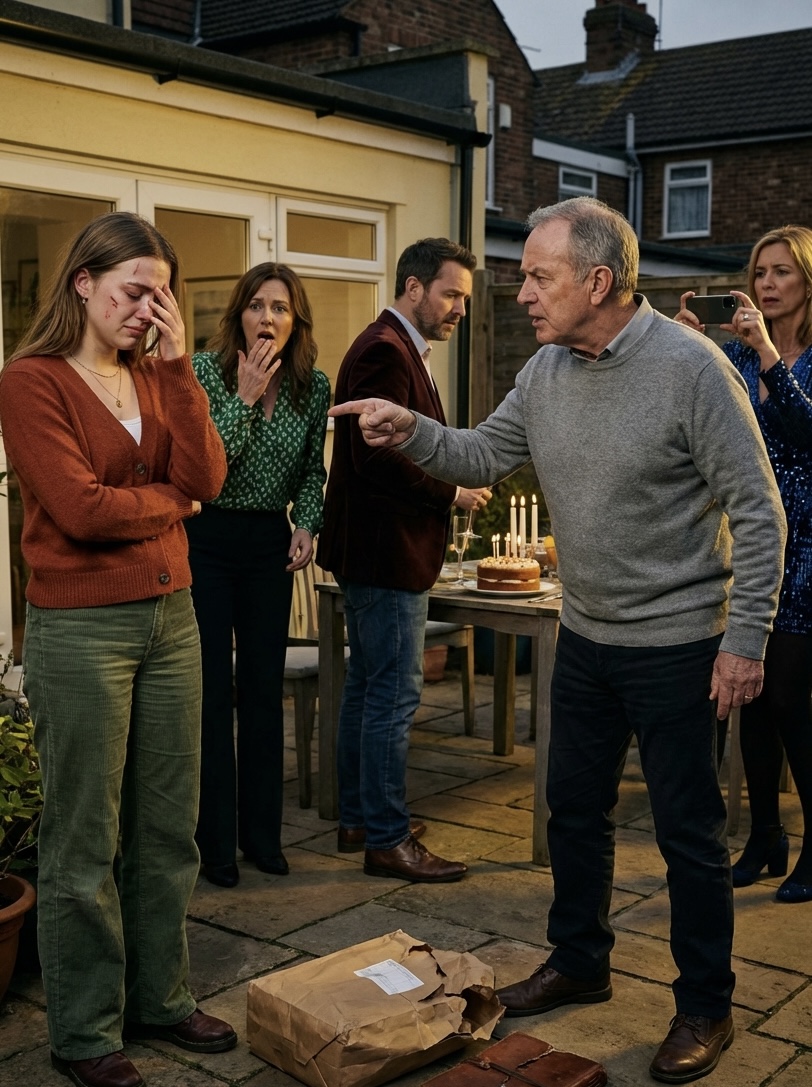
The sound cracked across the patio so sharply that every conversation stopped at once. One second I was standing there with the craft-paper package still half-open in his hand, and the next my face was burning, my head turned sideways, and a champagne glass had slipped from someone’s grip and shattered against the flagstones near my shoes.
“What kind of worthless junk is this?” Gerald Talbot shouted. “Three months and this is all you could get me?”
I tasted bl:ood where my teeth had cut the inside of my cheek.
My left side throbbed with heat. Around us, thirty guests sat frozen beneath string lights and polite suburban smiles. My adoptive mother, Donna, stared down at her plate.
My adoptive sister, Megan, perched on the arm of Gerald’s chair with her phone still raised, recording. A few people shifted awkwardly. Only our next-door neighbor, Ruth Kessler, stood.
“Gerald, that was uncalled for,” she said.
“Stay out of my family business,” he snapped.
Ruth sat back down, but she never took her eyes off me.
I’ve never forgotten that.
I bent to retrieve the wallet he had dropped like garbage, and for one humiliating second I wanted to beg him to understand. I wanted to explain how I had hidden tip money from my dishwashing job at Rosie’s Roadhouse, how I skipped lunch during shifts, how eighty-four dollars felt like a fortune when you earned eleven an hour and lived in a storage room beside a water heater.
But I said nothing.
My “room” wasn’t really a room. It was a windowless storage closet in the basement with a twin mattress Gerald had pulled from a curbside pile when I was nine.
Megan, meanwhile, had the queen bed upstairs, the vanity mirror, the credit card on his account, the easy laughter of someone who had never once questioned if she belonged.
By nine that night, the party had picked back up as if nothing had happened. Gerald laughed. Donna refilled glasses.
Megan showed guests the video she had taken of me getting slapped. I went downstairs, took my worn backpack off the wall, and packed everything I owned that mattered: two shirts, a pair of jeans without holes, a toothbrush, my charger, three hundred forty dollars in cash, and an envelope I had found months earlier in a box Gerald had thrown away.
It had a Virginia state seal and the words adoption assistance disbursement summary. I never fully understood it.
I just knew my name was on it, and Gerald had hidden it.
I walked out the front door without saying anything.
No one stopped me.
The October air was cold enough to sting the mark on my face. I walked down Patterson Avenue with my backpack digging into my shoulders and no plan except away. I made it two miles before headlights slowed behind me.
A black Cadillac Escalade pulled over.
The rear door opened.
A tall man in a dark coat stepped out, followed by a red-haired woman carrying a leather portfolio. His hands were shaking. Under the streetlight, I saw his eyes first—hazel green, wide-set, the exact same eyes I saw in the mirror every morning.
He stopped a few feet away and said quietly, “I’m sorry to frighten you.
My name is Richard Whitford.”
Then his voice broke.
“And I believe I’m your biological father.”
I didn’t get into the Escalade because I trusted him.
The photograph he handed me under the streetlight showed a woman with auburn hair and my face, holding a toddler with hazel-green eyes. Her smile tilted slightly left, just like mine. Her name, Richard said, was Catherine Whitford.
She di:ed in a car acci:dent when I was two. He had been in the passenger seat, badly injured, spending months in the hospital. During that time, social services placed me in emergency foster care.
When he recovered and tried to bring me home, the court told him he had voluntarily relinquished his parental rights.
“I never signed anything,” he said.
His attorney, Margaret Hale, opened her portfolio and showed me copies of old court records. A form existed with Richard’s name on it. A judge had approved it.
My adoption had been finalized. The file was sealed. By the time Richard challenged it, I had already disappeared into the Talbot family under a new name.
I kept waiting for the part where the story stopped making sense.
It never did.
At a Hilton off Broad Street, Margaret laid everything out.
Richard had spent years hiring investigators, reopening trails, comparing sealed records, and fighting for whatever scraps the system would give him. He had only recently found me, and they had been watching the Talbot house for weeks, trying to confirm my identity without scaring me. The birthday party gave them their first safe opportunity to approach.
Then I showed Margaret the state envelope I had kept from Gerald’s trash.
She read it once, and her expression changed completely.
“It’s an adoption subsidy summary,” she said.
“The state paid Gerald and Donna Talbot about eight hundred ten dollars a month for your care for eighteen years.”
I stared at her.
“That’s roughly one hundred seventy-five thousand dollars,” she added.
I thought about the storage closet. The curbside mattress. The missing medical records.
The fact that I had no birth certificate, no Social Security card, no driver’s license, no state ID—no documents of my own. I thought about Gerald calling me a burden every time I needed something that cost money.
I was never a burden.
I was a paycheck.
Once that truth settled, everything else shifted. I started cooking family meals at ten.
I did all the laundry by twelve. I walked to work because Gerald never let me learn to drive. Two weeks before the party, he had called me into his office and slid a legal document across the desk.
He wanted me to sign a “voluntary guardianship agreement” claiming I wasn’t emotionally or financially capable of living independently. Buried on page four was the real purpose: it would let him keep control of state and federal assistance tied to my care even though I was already twenty-one.
I had asked for time.
That’s why he slapped me. Not because of the wallet.
Because I said no for the first time in eighteen years.
The next morning, Richard brought me coffee and sat across from me in the hotel chair like a man afraid any sudden move might scare me off. He never asked for trust. He just answered my questions.
When I told him I wanted a DNA test before believing anything, he nodded once.
“Of course,” he said.
That word nearly broke me.
Of course.
No guilt. No offense. No demand for blind trust.
Just respect.
We went to an accredited lab in Richmond that afternoon. Five days for results. Five days while Margaret built the case.
She found a forensic handwriting expert who compared Richard’s real signature to the one on the relinquishment form. She uncovered bank records showing a five-thousand-dollar payment from Gerald Talbot to Leonard Grubb, the social worker assigned to my case, one week before the adoption was approved. She tracked down Derek Simmons from Virginia Social Services to assess my living conditions and misuse of funds.
She got Ruth Kessler to sign a sworn statement about the abuse she had witnessed.
On the fifth day, the DNA results came back: 99.998% probability.
Richard Whitford was my father.
I stared at the report until the numbers blurred. Then I cried—not because I was weak, but because I finally had proof that I hadn’t been unwanted. I had been taken.
The night before court, Margaret turned the hotel conference room into a war room.
Five stacks of evidence: DNA results, handwriting analysis, financial records, Derek’s report, Ruth’s affidavit. Richard said very little. When he did, it was only this:
“Whatever happens tomorrow, you are already free.”
The next morning, I walked into family court in a navy blazer and white blouse, my hair pulled back, shoulders straight.
He looked at me, then at Richard, then at the box of evidence on our table—and for the first time in my life, I saw him realize he might actually lose.
Gerald entered that courtroom like a man who had never been told no.
Gray suit.
Burgundy tie. Chin raised. Donna on his arm in a fitted dress.
Megan behind them, impatient, as if this was just another inconvenience delaying lunch. Gerald’s lawyer carried one thin folder. Margaret had a banker’s box.
That told me everything.
Judge Patricia Dwyer called the case, and Margaret began with the facts.
No drama. DNA first. Then the forensic report proving Richard’s signature had been forged.
Then the bank records showing the five-thousand-dollar payment to Leonard Grubb.