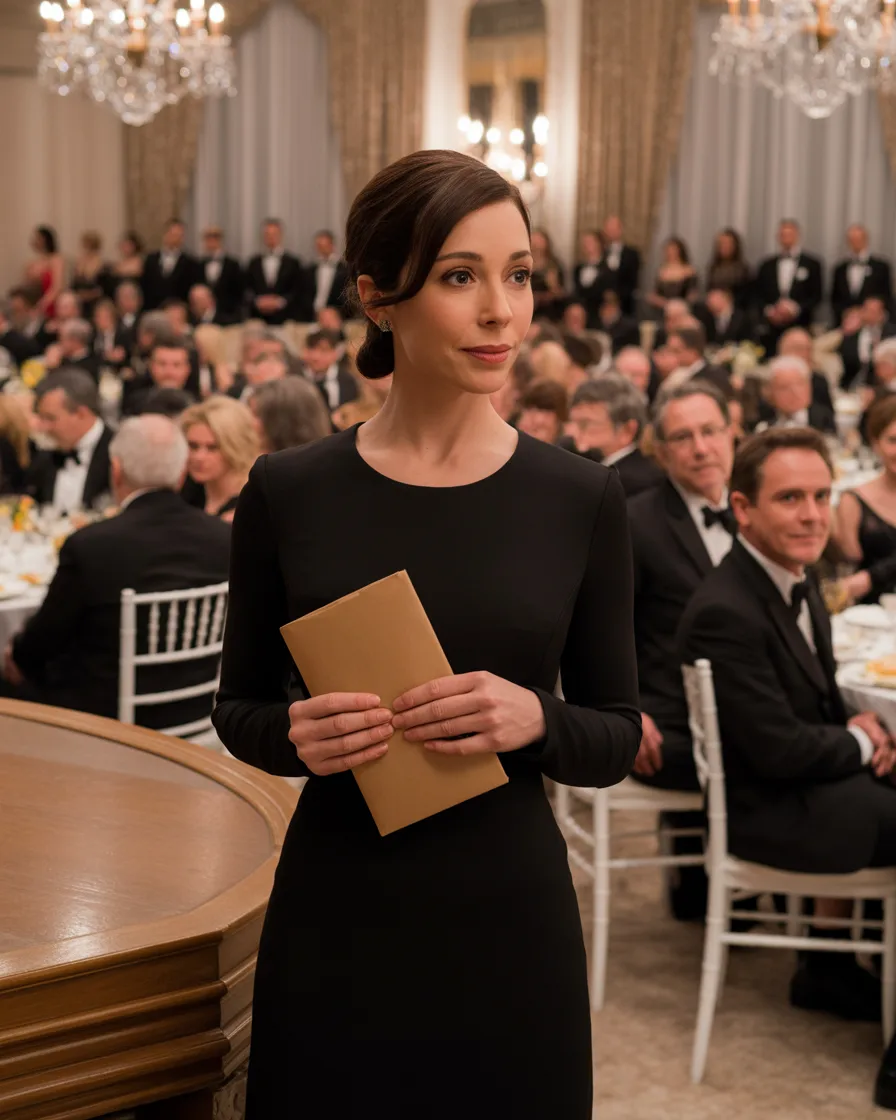
Vanessa was charged with forgery, identity theft, theft from an elder dependent adult, and financial fraud. Once the case went public, other irregularities surfaced — an accountant linked to shell accounts who cooperated, a former assistant who turned over emails, two donors who discovered she had fabricated or repackaged the origin of funds attached to several public gifts. Khloe was not charged, but the law requires more than vanity and entitlement.
My father filed for divorce within the month. The forged deed was voided, the Del Mar property returned to his name, the fraudulent credit line closed, the retirement distributions partially clawed back and covered through restitution orders and the court-ordered liquidation of Vanessa’s LLC holdings. The California Legal Foundation issued a public statement revoking the award and donated an equivalent amount from its reserve fund to a legal aid program for elder financial abuse victims.
Judge Carter sent me a handwritten note two weeks later. It said only: You were right not to stay quiet. I kept it in my desk drawer.
The harder part was not the legal proceedings. About three weeks after the gala, my father asked if he could come to the beach house. I almost said no — not to punish him, but because I still didn’t know which version of him would arrive.
He came without a driver, without gifts, without the old assumption that a father’s arrival was automatically welcome. He stood on the terrace with his hands in his coat pockets and looked out at the water while the late afternoon turned silver. “Your mother would have loved this place,” he said.
“She’s the reason I bought it.”
He nodded. After a while he said he had let things happen because it was easier than fighting all the time. He had told himself that keeping peace in the house mattered.
He hadn’t realized he was buying that peace with me. I did not rescue him from the sentence. “I cannot fix the years I handed away,” he said.
“But I don’t want to keep being the man who looked away.”
I believed he meant it. Belief, however, is not the same as restoration. “You’re my father,” I told him.
“I love you. But you don’t move into this house. You don’t make decisions here.
If you come, you come because I invited you. If you want a relationship with me, it will be a real one — not one managed by whoever is loudest in the room.”
He exhaled like someone who had been expecting something harsher and perhaps deserved it. “Understood.”
And for the first time in years, I believed that word had actually landed.
Over the following months, he did the least glamorous thing a damaged parent can do. He became consistent. He went to therapy.
He stopped letting other people speak for him. He called when he said he would call. He showed up when invited and didn’t when he wasn’t.
He answered uncomfortable questions without retreating into silence. We were not suddenly healed — life is not a movie — but there was movement, and movement counts. I moved my clothes back into the master suite the morning after Vanessa’s arraignment.
Opened every window and let the marine air strip her perfume from the rooms. Replaced the bedding. Put my mother’s photograph back in the study, this time in a walnut frame under proper light, with a small brass plaque on the shelf beneath it.
Eleanor Riley, who taught me not to confuse quiet with weakness. When the restitution funds cleared, I established a grant in my mother’s name for women undergoing ovarian cancer treatment who needed emergency financial support during unpaid medical leave. Modest at first, then larger after a second civil settlement.
Quiet money. Useful money. The kind that changes a week for someone rather than polishing a reputation.
That mattered more to me than the spectacle ever had. But I would be lying if I said the spectacle gave me nothing. There is a specific relief in watching a room full of important people understand that the woman they had been applauding built her image on theft and manipulation.
Not because public humiliation is noble, but because some predators rely on prestige the way others rely on locks. Once prestige cracks, everything underneath becomes visible. Vanessa accepted a plea agreement rather than risk trial.
She received a prison sentence, financial penalties, and a lifetime bar from serving on any nonprofit board handling donor funds. Khloe moved out of state within weeks and sent me one text: I hope you’re happy. I didn’t reply.
Happiness wasn’t the point. Truth was. Nearly a year after the gala, on a cool evening in March, I stood on the terrace with a glass of wine and listened to the waves below the bluff.
The house was quiet in the best way — not tense, not performative, just peaceful. My father had come for dinner and left at nine, after helping clear plates without being asked. Before leaving he paused by my mother’s photograph and touched the frame with two fingers.
He didn’t make a speech. He just said goodnight and meant it. The master suite was mine.
The ocean-view guestroom was empty and waiting for someone I actually wanted to invite. The back bedroom no longer held a trace of me because it never should have. Far out on the dark water, a boat’s white light moved steadily across the horizon.
I watched it for a while, then locked the terrace door, turned off the last lamp downstairs, and walked through my house with the easy certainty of someone who no longer needed anyone’s permission to belong there. That was the ending Vanessa never planned for. Not her arrest.
Not the ruined gala. Not the court orders. The real ending was simpler.
She failed to turn me into background. And in the house I bought with my own money, under a roof no one could take from me, I finally got to live in the center of my own life.