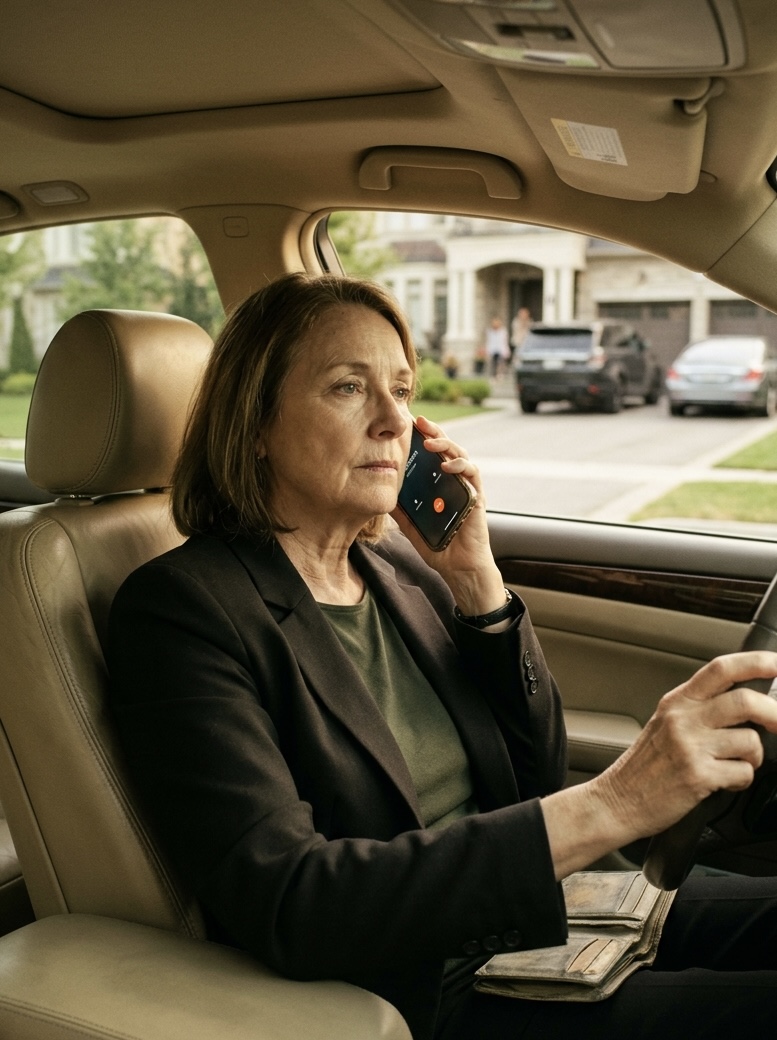
My son froze my cards at Whole Foods, then handed me $40 for groceries like I was a beggar. He thought he controlled our $42 million empire — until the bank called and told me he had tried to move $23 million from the one account he was never supposed to find.
The first time I understood that humiliation could arrive dressed in ordinary daylight, it happened under the bright white lights of a Whole Foods on a Tuesday morning in March.
I had parked in my usual spot, selected avocados, debated between sourdough and seeded rye, paused by the flowers because the dining room felt gloomy without something alive in the center of the table. Then the cashier swiped my card.
“It’s not going through, ma’am. Do you have another card?”
I smiled. The automatic social curve of a woman accustomed to smoothing moments before they become scenes. “That’s strange. Try it again.”
The terminal beeped its refusal a second time. I handed over my debit card. Declined. My emergency American Express — in my wallet for twenty-eight years, the one Warren had insisted I always carry. Declined.
The line behind me thickened. A man muttered something about people holding up the line. The cashier looked embarrassed for me. I said I was sorry, though I had done nothing wrong.
In the parking lot, inside my Mercedes, I laid my wallet open on the passenger seat. Three credit cards. One debit card. All declined. All dead.
My son. Desmond.
I called the bank from the parking lot, fingers trembling. The representative said: “Mrs. Morrison, I’m showing that your accounts were frozen this morning at 6:47 a.m.”
“Frozen by whom?”
“I’m sorry, ma’am. You’ll need to come into a branch with identification.”
I drove straight to Desmond’s house.
I wanted there to be a harmless explanation. People talk about denial as if it is stupidity. It isn’t. Most of the time denial is simply love’s final defense before it has to admit what it has attached itself to.
Karen opened the door wearing tennis clothes and a face that instantly told me I had not been the victim of a misunderstanding.
“Desmond’s blocked your number,” she said casually. “He said it was time for boundaries.”
Boundaries. How the selfish love therapeutic language.
Desmond appeared behind her. Same shoulders as his father Warren. Same dark hair. But Warren had always carried warmth toward me in his face. Desmond’s expression was flat and cold and already decided.
“Yeah,” he said. “I froze them.”
“We need to have a serious conversation about your spending, Mom. Somebody has to protect the family assets.”
I stared at him. “I bought groceries.”
“This isn’t about groceries. It’s about the larger pattern.”
What pattern? Warren and I had built twelve dealerships across three states. Commercial real estate, investment accounts, trusts, liquid assets. I could have bought every avocado in that Whole Foods and still not dented a quarterly interest statement.
“I want my accounts restored,” I said. “Now.”
Karen laughed softly. “You’re not listening. This is bigger than your cards.”
Then Desmond said the sentence that made the morning tip from ugly into catastrophic.
“We’re selling the dealerships.”
“Prestige Auto Consortium made an excellent offer. Thirty-eight million cash for all twelve locations. The papers are being drafted.”
I looked from him to Karen and back.
“You cannot sell Morrison Auto Group,” I said. “That company belongs to me.”
Karen rolled her eyes. “Parts of it belong to you on paper. But functionally? Let’s be honest. You don’t run it anymore.”
A lie, strategically chosen. I remained CEO. I signed off on expansions. I reviewed financials. I approved hires. I still owned the controlling interest.
“Without my signature, there is no sale,” I said.
Desmond took out his phone and held it up. A document on screen. My own signature unmistakable at the bottom. A power of attorney I had signed before gallbladder surgery. “Just in case anything needs a quick decision while you’re recovering, Mom,” he had said. I signed because he was my son.
“You had authority if I was incapacitated,” I said. “I am not incapacitated.”
Karen gave a little laugh. “That’s where things get uncomfortable. Desmond’s attorney believes there’s enough documentation to establish cognitive decline.”
I understood then that this had not begun that morning. Every time she had corrected me over a small detail at dinner. Every time she had said “Didn’t we already talk about that?” in front of other people. Every time she had made that tiny expression of patient concern. They had been laying groundwork.
“I am seventy-three. Not senile.”
They went on, speaking about my life like consultants reorganizing a company division. My house. My money. My business. My future body, reduced to probable inconvenience and estimated risk.
Then Desmond reached into his wallet and held out two twenty-dollar bills.
“Here,” he said. “For groceries.”
Forty dollars.
I have survived miscarriages, bankruptcy scares, my husband’s heart attack, the funeral that followed, the first night sleeping alone in the house we built together. Few things can still truly astonish me. But watching my son offer me forty dollars as if I were a little old woman who needed an allowance from the people using her money — that astonished me.
“I would rather starve,” I said quietly, “than take scraps from my own son after he steals what his father and I built.”
Then Desmond delivered the most deliberate cruelty of the morning.
“If you fight us on this, you won’t see Emma and Tyler again. We’ll tell them Grandma isn’t well. Kids adjust.”
There are threats, and then there are revelations disguised as threats. No decent man threatens a mother with her grandchildren to force the surrender of her own life. That was not desperation. That was character.
I turned and walked away.
In my car outside, I gripped the steering wheel. Through the windshield I could see the top of Karen’s hydrangeas. A child’s scooter on its side near the garage. Everything looked so normal.
Then my phone rang. Unknown number.
“Mrs. Morrison? This is Frederick Peton, senior vice president of private wealth management at First National Bank. We’ve been trying to reach you regarding unusual activity on your accounts.”
“What unusual activity?”
“There were several large transfer attempts this morning using your login credentials. Approximately twenty-three million dollars across multiple accounts.”
Twenty-three million.
This had never been about my spending. Or my age. Or caution. It had always been theft.
“The transfers were flagged by our security systems,” Frederick continued. “The majority did not go through. But a smaller amount appears to have moved before the holds triggered.”
Five years ago in a hospital room, Warren had squeezed my hand and said: “Nora, promise me something. Protect yourself from everyone. Not just strangers. Everybody. Money changes people. Sometimes even the people we think it won’t.”
I had protested. “Not Desmond.”
Warren had looked at me in that painfully loving way. “I hope not. But hope isn’t a plan.”
It was Warren who insisted on secondary trust structures, overseas holdings, accounts requiring physical presence and biometric authorization. At the time I half thought he was overreacting. Now, sitting outside Desmond’s house with Frederick’s voice in my ear, I understood that Warren had not been overreacting at all. He had been loving me in advance.
The protected accounts: primary trust, offshore holdings, investment accounts, rental income accounts Desmond had never asked about because rental property bored him. Enough protected assets that despite the freeze on my daily accounts, the majority of my wealth remained untouched.
He thought he had taken everything.
He thought he had made me helpless.
I drove downtown to the bank. Frederick met me himself, silver-haired, neat. He looked me straight in the eye and said, “I’m very sorry this is happening.” Not sympathy. Not pity. Recognition.
We spread documents across his conference table. The bank’s counsel, Elise, read legal language the way a surgeon reads scans. After twenty minutes she looked up. “He exceeded the authority granted here by a wide margin.”
Gaslighting thrives in isolation. The first antidote is often simply hearing a competent stranger say: No, you are not imagining this. Yes, it is exactly what it looks like.
She showed me the transfer attempts. Two destination accounts linked to shell entities connected to the dealership acquisition vehicle. One personal investment account. One account in Karen’s maiden name. He had not only tried to seize control — he had already begun positioning the proceeds.
One hundred forty thousand dollars had gotten through before the protocols cascaded. A fraction of what he wanted. Enough to tell me this had been building for a long time.