“Someone who’s stronger than I thought. Someone who can handle difficult circumstances without compromising his principles. Someone who understands that respect has to be earned every single day.”
“I’m proud of you, Ethan.”
“Are you really?”
“I’m proud of the man you’re becoming.
I’m proud of the choices you’re making. I’m proud that you’re using this experience to grow rather than just survive.”
“When I get out, I want to make amends—not just to you, but to the people I took from. I want to pay restitution even if the court doesn’t require it.”
“How will you do that without money?”
“By working.
By earning enough to pay back what I took, even if it takes years.”
“It’s the only goal that matters. I need to prove to myself that I can be someone worth respecting.”
After he hung up, I sat in my study looking at the family photos that lined the shelves. Images of birthday parties and graduations.
Family vacations and holiday celebrations. All the milestones of what had appeared to be a perfect family life. But none of those photos captured what I was seeing now.
My children becoming people of genuine character, strength, and integrity. The transformation had required destroying everything they thought they knew about themselves. But the people emerging from that destruction were worth the pain.
Tomorrow would bring new challenges. Sophia would start her new job, taking on responsibilities that would test her newfound maturity. Ethan would continue serving his sentence, learning to navigate a world that didn’t care about his former privileges.
But for the first time in 30 years of motherhood, I was genuinely excited to see who my children would become. They were no longer the entitled, dependent people I had raised. They were becoming strong, principled adults.
People I would choose to know even if they weren’t my children. That was the greatest success of all. Eighteen months after that first terrible phone call—after being called a pest, after hearing that my own son would rather lose his mother than his sister—I stood on the balcony of my new penthouse apartment overlooking the Pacific Ocean.
The view was breathtaking. Waves crashed against the rocky coastline below while seagulls wheeled through the salt-tinged air. The sun was setting, painting the sky in shades of rose gold and amber that no photograph could ever capture.
I had sold the family home three months earlier. The decision had been practical as much as symbolic. The Tudor mansion where I had raised my children, where Marcus and I had built our life together, had become a monument to relationships that no longer existed.
Every room held memories of the people my children used to be. And I found I preferred to remember them as they were becoming. The sale had been remarkably easy.
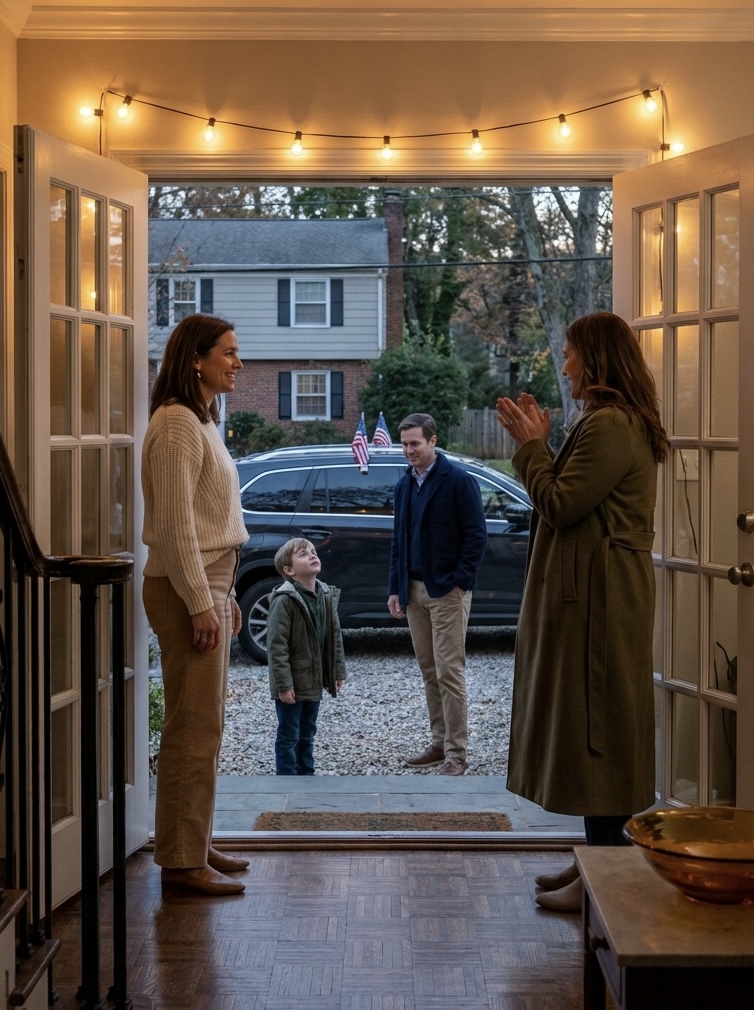
The house was worth considerably more than I had paid for it 35 years earlier, and the buyer—a young tech entrepreneur and his pregnant wife—had fallen in love with it immediately. “We want to fill it with children,” the wife had said during the final walk-through. “We want it to be a place where family memories are made.”
I had smiled and wished them well, hoping they would be wiser parents than I had been.
The proceeds from the sale, combined with my other investments, had given me the financial freedom to recreate my life entirely. I had chosen this coastal city specifically because it was far enough from my old life to represent a true fresh start, but close enough that my children could visit when they chose to. Sophia had been the first to visit the new apartment.
She had taken a week off from her management position—she was now overseeing three locations and being considered for regional management—to help me settle in. “Mom, this place is incredible,” she had said, standing on this same balcony. “You can see for miles.”
“That was the point,” I told her.
“I wanted to be able to see the horizon.”
“Symbolic much?” she teased. But there was warmth in it. We spent the week shopping for furniture, exploring the neighborhood, and talking in ways we never had before.
Sophia had matured into someone I genuinely enjoyed spending time with—thoughtful, funny, and refreshingly honest about her continuing struggles and growth. “Do you miss it?” she asked on her last evening. “The old house, the old life, all of it.”
“I miss Marcus,” I replied.
“I miss the dream of what our family could have been. But I don’t miss the reality of what it actually was.”
“And what was it actually?”
“A beautiful performance that none of us understood was hollow until it collapsed.”
She nodded thoughtfully. “I’ve been thinking about that a lot lately—about the difference between looking successful and actually being successful.”
“And what’s the difference?”
“Looking successful means maintaining an image.
Being successful means building something real.”
Ethan had been released from jail two months later. I had driven the four hours to pick him up, arriving at the county facility on a gray Tuesday morning that felt nothing like the momentous occasion it actually was. He emerged carrying a paper bag containing his few possessions, wearing the same clothes he had been arrested in—now hanging loose on his thinner frame.
But there was something in his posture, in the way he carried himself, that suggested jail had built him up even as it had worn him down. “Thank you for coming,” he said as we drove away. “Where else would I be?”
“I wasn’t sure you would.
I wasn’t sure I deserved you to.”
“You served your time, Ethan. You paid your debt. Now you get to figure out what comes next.”
What came next, it turned out, was a job at a legal aid clinic helping people navigate the justice system.
People who couldn’t afford private attorneys and were intimidated by the complexity of court procedures. The work paid a fraction of what he had earned at the prestigious firm. But it provided something his old job never had.
A sense of purpose. “I spend my days helping people who are facing the same system that humbled me,” he told me during one of our weekly phone calls. “People trying to get their records expunged.
Immigrants dealing with proceedings. People who made mistakes and are trying to rebuild their lives.”
“Like I’m finally using my education for something that matters. Like I understand why I went to law school in the first place, which was to help people navigate systems that seem designed to defeat them.”
“I just got distracted for a while by the idea that success meant making rich people richer.”
Both of my children visited me for the holidays—the first Christmas we had spent together in two years.
They stayed in the guest rooms of my penthouse. We cooked together. Walked on the beach.
Talked late into the evenings about books and politics and their plans for the future. It was the best Christmas I could remember. “You know,” Sophia said on Christmas Eve as we watched the sunset from my balcony, “I used to think happiness meant getting everything you wanted.”
“Now I think it means wanting what you’ve earned.”
“And what have you earned?”
“Peace.
Self-respect. The knowledge that I can handle whatever life throws at me.”
“Those are valuable things—more valuable than anything I used to think I wanted.”
Ethan, who had been quietly listening, spoke up from his chair near the railing. “I used to think strength meant never having to ask for help,” he said.
“Now I know it means being brave enough to ask when you need it.”
“What made you realize that?”
“Jail, mostly. You can’t survive in there without learning to rely on other people and having them rely on you. It’s humbling, but it’s also liberating, I guess.”
“Liberating how?”
“When you stop pretending you don’t need anyone, you can build real relationships instead of transactional ones.”
As I listened to my children—really listened, in ways I hadn’t been able to when I was focused on controlling their lives—I felt a satisfaction deeper than any I had experienced during the years of their apparent success.
These were people I was proud to know. Not because of what they owned, or whom they knew, or what images they projected. But because of who they had become when stripped of every advantage except their own character.
“Can I ask you both something?” I said as the last light faded from the sky. “Of course,” they said almost in unison. “Do you understand now why I did what I did?”
They looked at each other.