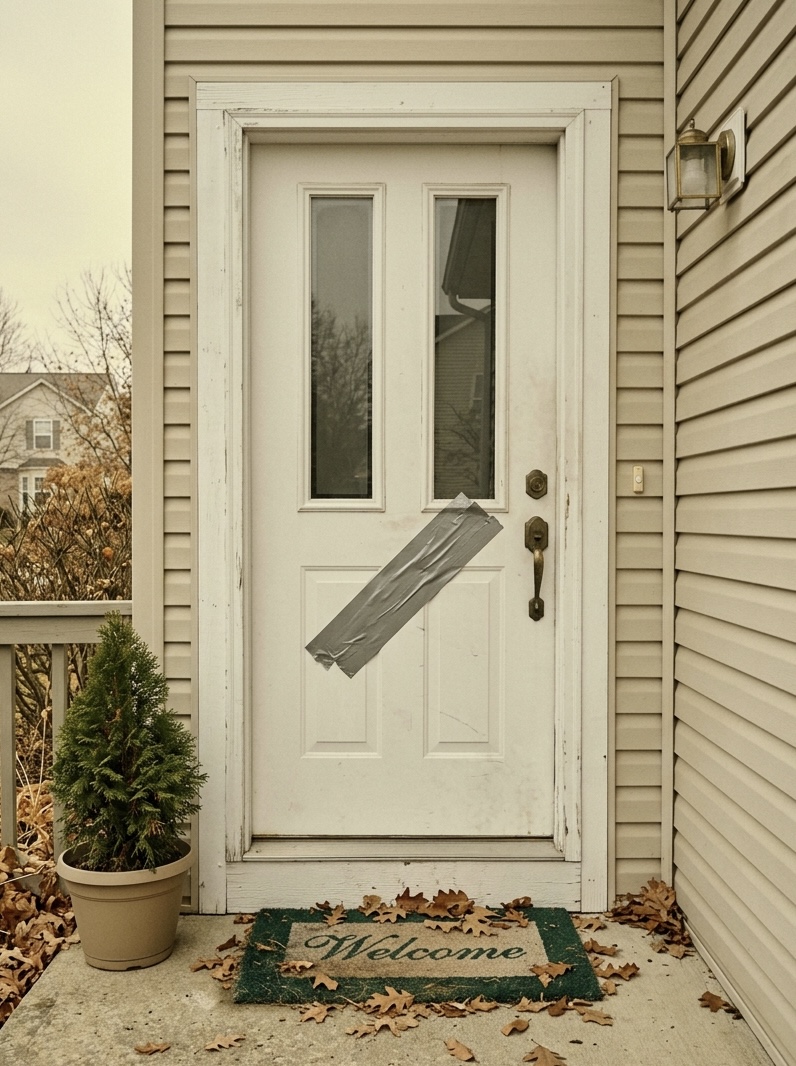
In the kitchen, a second crack had opened above the back door.
Outside, someone shouted, “Move away from the front walk!”
I went into the bedroom for a few more clothes and felt the floor give a little under my right foot.
Then the power cut.
The house went dark.
And in that sudden silence, I heard a deep groan from below. Long. Slow. Structural.
A woman farther down screamed.
I grabbed the duffel and ran.
Two workers were already backing away from my porch.
“Come on,” one of them yelled.
I got down the steps and into the street just as the concrete walkway dropped with a sharp crack. Not all the way. Just enough to tilt and split.
A woman farther down screamed.
“I knew enough to leave.”
We all turned and watched the empty house two doors over sink at one front corner. First, the porch sagged. Then the foundation dipped. Slow enough to see. Fast enough to understand.
I stood in the street holding a duffel bag, a framed photograph, and a metal box while my house made sounds a house should never make.
Her eyes filled immediately. “I knew enough to leave.”
“You could have told me plainly.”
“I noticed the dishes first. Then the cabinets.”
“I tried.”
“No, you didn’t.”
She took that without arguing.
Then she said, “I noticed the dishes first. Then the cabinets. Then the front steps pulled away from the porch by half an inch. I told Gary. He said houses settle. I told Paula. She told me not to scare people. Then the inspector came.”
“He told me they had found voiding under the street after the water-line work,” she went on. “Said they were checking which properties sat over it. Said not to spread rumors until they finished the maps.”
One side of the roof was lower than it should have been.
“And you listened?”
“For one day. Then they told me my house was probably in the first row.”
I looked at my own place. One side of the roof was lower than it should have been.
“I told a city worker you still lived here,” she said. “I told him yesterday. And I told another one tonight when I saw the trucks turn in. I thought they’d get to you before it got worse.”
An older man in a city jacket joined us. He had that worn-out official look. Too much coffee. No sleep.
“The system failed before the tape ever mattered.”
“Sir,” he said to me, “I’m sorry. The parcel record for your address still has the previous owner’s mailing contact. The notice team flagged no response. Evening shift marked it unconfirmed. Night crew inherited ‘likely vacant.'”
I stared at him. “That’s your explanation?”
“It’s the truth.”
“Was the tape the entire system?”
“No,” he said. “It was a field marker for the crews working after dark. The system failed before the tape ever mattered.”
I opened it but didn’t invite her in.
That, at least, sounded honest.
By sunrise, the whole row was fenced off.
They put us in a motel near the highway. Linda, me, and a couple from farther down the block. I sat on the bed with my wife’s picture on the nightstand and my papers under the lamp and felt about a hundred years old.
Later that afternoon, Linda knocked on my door holding two coffees.
I opened it but didn’t invite her in.
That was the first thing she said that made me stop being angry for a full second.
She nodded like she understood. “I should have said the words. Not hints. Not pieces. The words.”
“Yes.”
She looked down at the coffee tray. “I was scared of being wrong. Then scared of being right.”
That was the first thing she said that made me stop being angry for a full second.
***
Three days later, city engineers took small groups back to collect whatever could still be reached safely.
I looked at the cracked front window.
When my turn came, I rode over in a van and stood across from my house while an engineer said, “We can probably give you 10 minutes.”
I looked at the cracked front window. The tilted steps. The gap where the walkway had dropped.
Then I looked at the photo in my hands. The one thing I had wanted most.
And I said, “No.”
The engineer frowned. “Sir?”
Something had been happening for a long time under all of us.
Because it was hopeless now. Even if part of it was still standing.
I used to say nothing ever happened on my street.
I was wrong.
Something had been happening for a long time under all of us.
Bad records. Slow answers. signs. Cracks nobody wanted to name.
That isn’t home.
Tonight I’m writing this from the motel. My wife’s photo is on the bedside table. My papers are under the lamp. The floor under me is solid.
That isn’t home.
But right now, it’s enough.