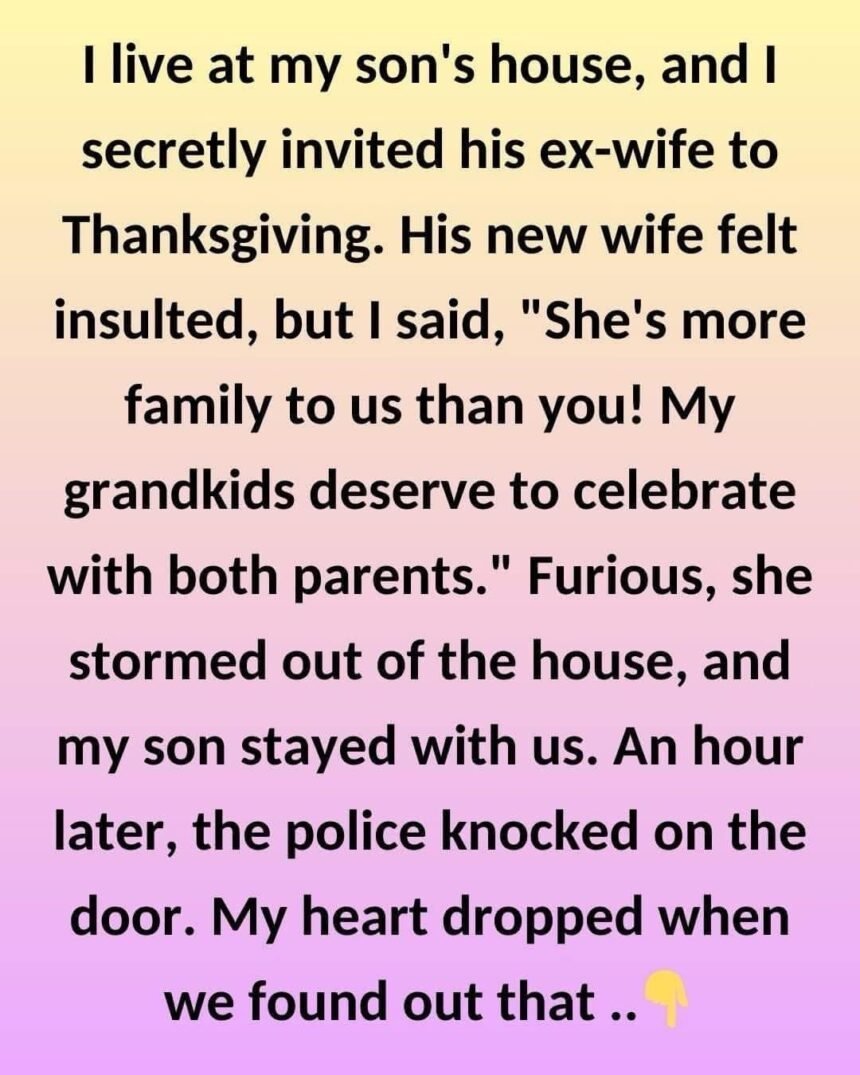
Thanksgiving is often treated as a sacred, immutable theater—a time where we are expected to perform the roles of a perfect family. For Olivia, that theater required a specific cast, and she decided to curate it without the consent of the people living in the house. Her son’s home was the stage, and she treated his current wife as a secondary character in a play she didn’t get to co-write.
When Olivia secretly invited her son’s first wife to Thanksgiving dinner, she wasn’t just inviting a guest; she was unilaterally rewriting the boundaries of her son’s household. She didn’t see the conflict as an invasion of privacy; she saw it as an act of noble, grandmotherly love. She told herself that the “grandkids deserved both parents,” completely bypassing the reality that the children’s parents had moved on, and that her son’s current home was not a neutral territory for her to manipulate.
The confrontation was swift. When the new wife expressed offense, Olivia’s response was not one of apology or mediation; it was a verbal execution of the new wife’s status in the family: “She’s more family to us than you!”
That sentence wasn’t just a slight; it was a declaration of war. It stripped the current wife of her place in the home she built, effectively telling her that her presence was conditional and inferior. It is little wonder, then, that the holiday shifted from dinner to a police-involved nightmare.
The Breaking Point: When Pain Becomes Performance
The unexpected knock of the police—the flashing lights, the questioning, the public humiliation—was the culmination of the new wife’s feeling of powerlessness. She was an outsider in her own home, overruled by a mother-in-law who held the “history” of the family as a weapon. While her decision to call the police was an act of extreme, vengeful sabotage, it was the desperate move of a woman who felt she had no other voice.
When the police cleared the house and the son was released, the silence that followed wasn’t the relief of a crisis averted; it was the suffocating reality of a marriage cracked by external interference. The wife’s confession—that she sabotaged the evening because she felt “unwelcome in her own home”—is the heart of the tragedy.
The Illusion of “The Right Thing”
Olivia’s question—“Did I do something wrong?”—is the classic refrain of the person who prioritizes their own vision of “family” over the reality of the people currently living it.
The Violation of Autonomy: Olivia lived in her son’s house, which placed a burden on her to be a guest, not a matriarch. By inviting an ex-wife into a space she didn’t own, she violated the fundamental right of a couple to curate their own environment.
The Myth of Neutrality: Olivia justified the invitation by claiming it was for the “grandkids.” But the grandkids’ experience is filtered through their parents’ stability. By creating an environment of intense, visible conflict, she did far more damage to their holiday than the absence of their mother would have.
The Cost of “Family History”: Olivia’s attempt to preserve the “old family” effectively destroyed the stability of the “new family.” In her eyes, she was being a grandmother; in the new wife’s eyes, she was an aggressor.
The Verdict: The Price of Being Right
Olivia may feel that her intentions were pure, but the road to social isolation is often paved with “good intentions.” By weaponizing her status as the mother-in-law and the “keeper of the grandkids,” she proved to her son’s current wife that she would never be an ally.
The tragedy here isn’t just a Thanksgiving ruined; it is a bridge burned. Olivia succeeded in getting the dinner she wanted, but in doing so, she became the architect of a conflict that will haunt that house for years to come.
When you weigh the desire to keep “the family together” against the necessity of respecting the current boundaries of a household, do you think it is ever possible to invite an ex-partner into a space without destroying the trust of the current partner, or is that a line that should simply never be crossed without explicit agreement?