“I’ll call the hospital Monday and ask what they need,” Callen said. And just like that, without any warning, we became something none of us had planned to be.
I drove Tom to two of his weekly treatments when Rosa’s back gave her trouble. Sometimes he’d find me in the waiting area afterward and show me the sticker the nurses had given him, holding it out very seriously. “They said I was brave today, Miss Megan!” he told me one afternoon, pressing the sticker to his jacket.
“Were you?”
Tom thought about it. “A bit scared, too. But mostly brave.”
He seemed satisfied with that.
Elena and I found our way to something real in those months. She’d come over for dinner some evenings, and we’d talk about ordinary things: a book she was reading, the way Tom had started insisting on choosing his own outfits in the morning. She was carrying our daughter, and I was helping keep her son alive.
And somewhere in the middle of that, the line between what was mine and what was Elena’s became something I stopped trying to draw. Our daughter arrived on a Sunday morning in early spring. Six pounds, four ounces, tiny fingers, and the most indignant expression I have ever seen on a newborn.
Callen cried immediately, tried not to, and then completely gave up. I held her against my chest and couldn’t find a single word, so I just let it be real. Elena was in the recovery room down the hall.
When the nurses asked if she wanted to hold the baby first, she shook her head. “She’s yours, Meg,” she said, looking at me. “She was always going to be yours.”
I held her hand and couldn’t say anything, so I just squeezed it.
Elena squeezed back. Three weeks later, Tom’s doctor called with his latest results. The treatment was working.
Numbers were moving in the right direction, slowly but steadily. Elena was standing in our kitchen when I told her. She pressed one hand flat on the counter and took three long, slow breaths before she could speak.
“Okay,” she finally said, and her voice broke on that one word. That evening, I watched from the back porch as Elena walked Tom slowly around the yard in the last of the light, his small hand in hers. A week later, Callen and I asked Elena, Rosa, and Tom to move into the guest house permanently.
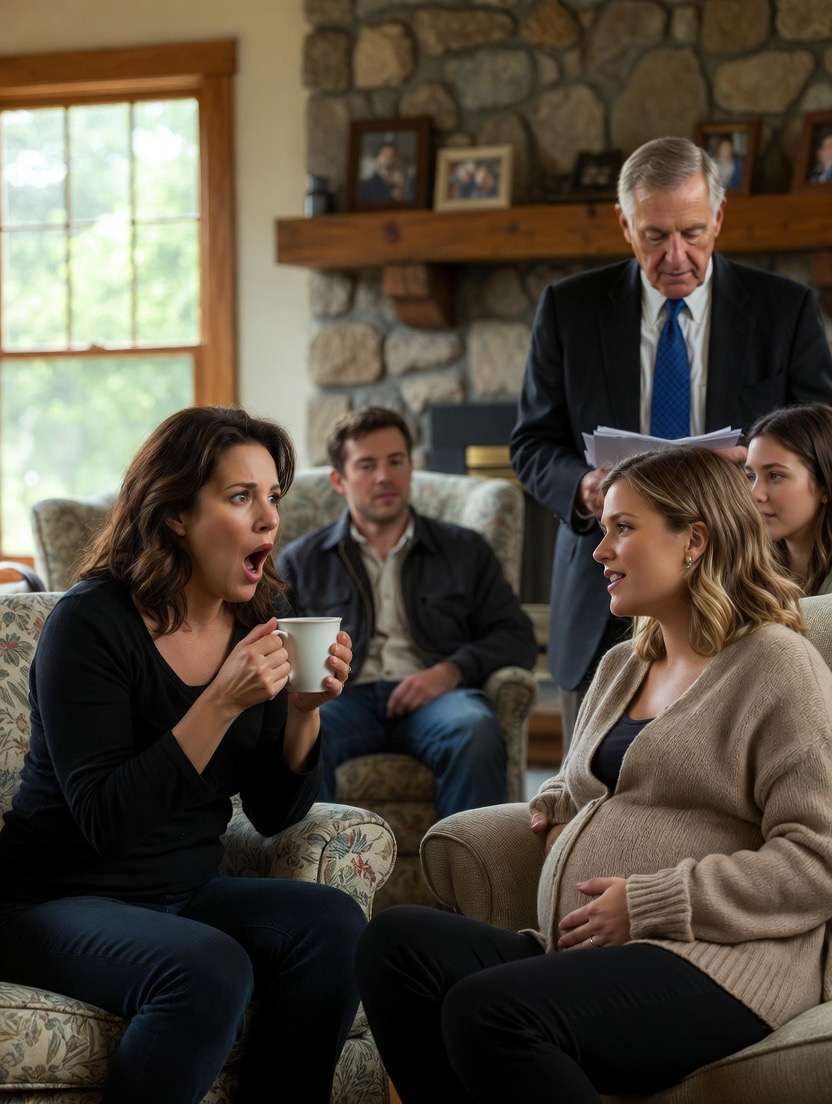
We sat them down and said that we wanted them close, that Tom needed stability while he finished treatment, and that the guest house was sitting there empty for no good reason. Rosa looked at me over her coffee cup. “You’re sure about this?”
“We’re sure,” Callen said.
Tom looked up from the drawing he’d been working on at our kitchen table. “Does that mean I can come over for breakfast sometimes?”
“Every morning, if you want,” I told him. Tom went back to his drawing, apparently satisfied.
Some evenings now, I look out the kitchen window and see the light on in the guest house, and I think about the night I crossed that yard in the dark, certain I was walking toward something that would break me. Then I think about everything I found instead: a little boy with a scrape on his knee, a woman carrying more than anyone should carry alone, and a truth that asked me to be bigger than my fear. And on the mornings when Tom shows up at our back door with his drawing pad and announces he’d like pancakes, I think we all managed it.