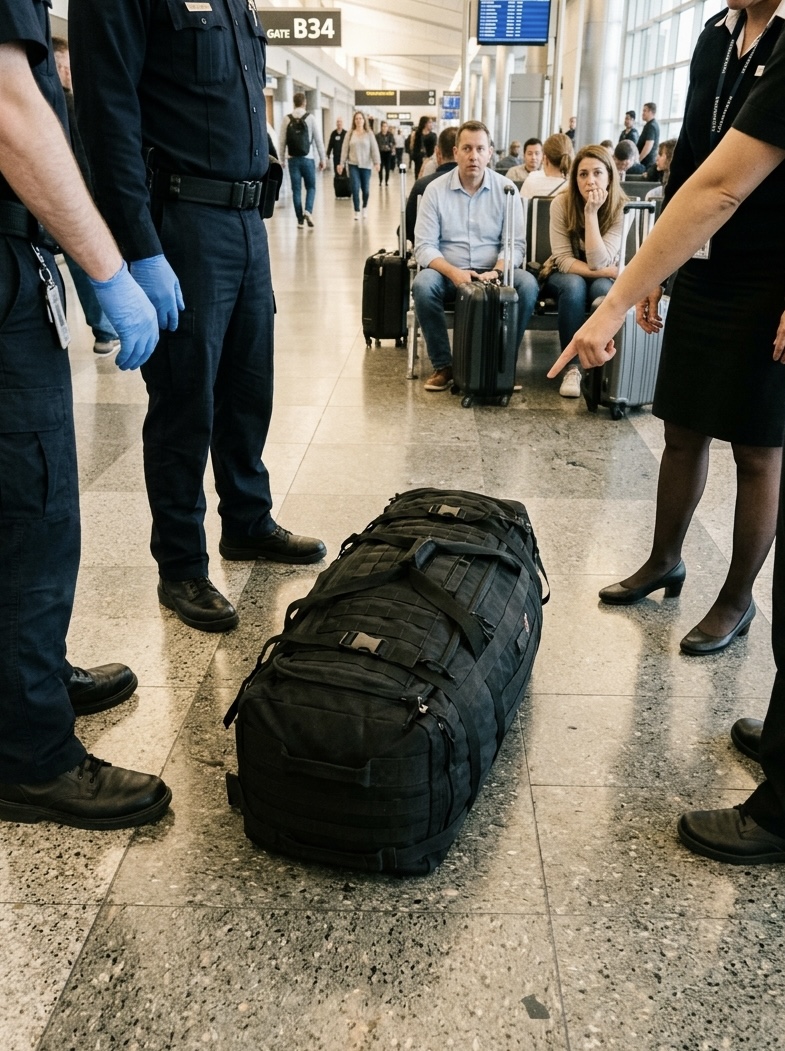
The officer lifted the rabbit gently, then set it aside. Underneath were carefully wrapped birthday presents tied with faded ribbons. The paper was worn at the edges, as if it had been handled year after year but never opened.
And resting on top of everything was an old framed photograph.
The woman had warm eyes and dark hair tucked behind one ear. The child grinned so wide it made my chest ache, one hand pressed against the glass as if she were pointing at the plane outside.
The older officer beside me went still.
He stared at the photograph for several seconds. His face softened, then collapsed into recognition.
“Oh God,” he muttered quietly. “It’s Walter again.”
I turned to him. “Walter?”
The officer let out a slow breath and rubbed one hand over his mouth.
“The man who gave you the bag,” he explained. “His name is Walter.”
I looked back toward the gate, searching again for the gray jacket, the tired eyes, the man who had apologized like he was sorry for more than leaving luggage behind.
The officer glanced at the bag, then at me. His voice lowered, not because he was hiding the truth, but because it deserved gentleness.
“Years ago, Walter was supposed to fly with his wife and daughter on a family trip. Seattle, actually.” He paused. “Work kept delaying him. Meeting after meeting. He convinced them to fly ahead without him and told them he would join them the next morning.”
A cold feeling moved through me.
The officer’s eyes drifted to the photograph again.
“Their plane never made it.”
The sound of the airport continued around us, but it felt far away. Boarding announcements, rolling suitcases, restless children, all of it faded beneath the weight of that sentence.
I looked at the presents, then at the little pink sneakers, and suddenly understood why the ribbons were faded. Why the clothes looked loved but untouched.
“He brings it here?” I asked.
The officer nodded slowly. “Every year around the same date. He comes back carrying the same bag filled with gifts he never got to give them.”
“And he just leaves it with strangers?”
“Not usually like this,” the officer admitted. “Sometimes he sits with it for hours. Sometimes he asks someone to watch it while he takes a call that isn’t really happening.” His eyes met mine. “He’s harmless. Just lonely.”
I swallowed hard, but the lump in my throat stayed there.
For the first time all morning, I stopped thinking about myself. My fear, my shaking hands, the humiliation of people staring at me. All of it fell away as I stared at the contents of that bag.
A father’s regret. A husband’s grief. Birthdays that never came. A trip that never ended. A goodbye he had not known he was saying.
Another officer leaned closer to the bag.
“There’s an envelope,” she said.
She pulled it carefully from between the presents. It was sealed, with no name written on the front.
“For her?” the older officer asked.
The officer looked at me. “I think so.”
I almost did not open it. Some part of me felt like the grief inside that bag did not belong to me.
But Walter had left it with me.
I slid my finger under the flap and unfolded the note.
The handwriting was shaky but careful.
You reminded me of my wife and daughter.
My breath caught.
I overheard your phone conversation with your mother.
I had not even realized I had spoken aloud earlier. Maybe when Owen called. Maybe when I whispered, “I can’t do this,” after sending him to voicemail. Maybe Walter had heard more than I meant for anyone to hear.
I kept reading.
Please don’t wait too long to love people back.
The words blurred.
I asked you to watch the bag because I needed someone kind enough to open it.
Tears burned behind my eyes, then spilled before I could stop them.
The older officer’s voice softened. “Sometimes people hand us things because they’re too heavy to carry alone.”
I looked down at the photograph again. Walter’s wife smiled from behind the glass. His daughter’s little hand stayed frozen against that airplane window, forever excited about a trip she would never finish.
I thought of my mother’s missed calls.
I thought of every time I had let pride answer for me. Every short reply. Every birthday that I had treated like an obligation. Every “I’ll call later” that turned into another week.
I sat by the window and buckled myself in, but I barely noticed the safety announcement or the passengers settling around me.
For the rest of the flight, I could not stop staring at my mother’s contact name on my phone screen.
Mom.
Just three letters, but they seemed to hold every year I had wasted pretending distance was protection.
When the plane finally landed in Seattle, everyone around me stood at once, reaching for bags and checking messages. I stayed seated.
Then, before I could lose the courage again, I pressed “Call.”
It rang twice.
Then my mother answered, her voice fragile but familiar.
“Emily?”
I closed my eyes as tears slipped down my cheeks.
“Hi, Mom,” I said, my voice breaking. “I’m sorry I took so long.”
But here is the real question: When life leaves a stranger’s grief at your feet and your own regrets waiting on the other end of a phone, do you keep running from the people you love, or do you finally answer before silence becomes permanent?