Time stretched in a way that felt both compressed and endless, every minute heavy with the knowledge that a frightened child had relied on a single phone call to start this chain of events.
By early afternoon, word came that footprints had led officers to a weathered cabin partially concealed among mesquite trees.
Negotiators attempted contact, but when no cooperation followed, a tactical team entered the structure.
Brooks’ call came minutes later.
“Mrs. Hayes, your granddaughter is safe,” he said, and the word safe broke something inside me that had been braced against the worst.
“She’s dehydrated but responsive.”
I lowered myself onto the pavement beside the car, tears blurring the world into indistinct shapes.
“And Maren?”
There was a pause, though not the kind that signals despair.
“She’s alive. She was found unconscious but breathing.
Paramedics are evaluating her now.”
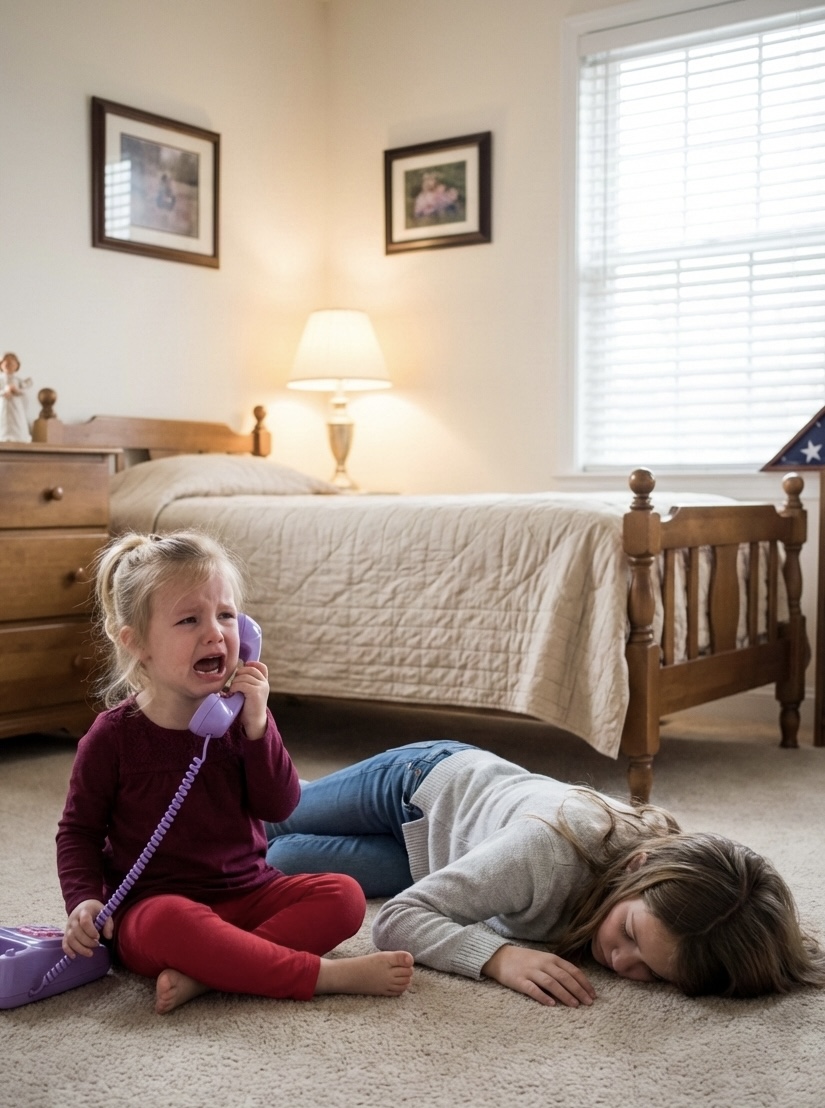
Later, at the hospital, Tessa ran into my arms with a force that nearly knocked me backward, her small body shaking as she tried to explain between sobs.
“He said if I screamed, it would be worse,” she whispered.
“But when he went outside, I used my tablet.”
I held her face in my hands and met her eyes.
“You were brave,” I said. “You trusted your instincts.”
Behind us, Maren lay pale but stable, her hand squeezing mine weakly when she regained awareness.
“I thought I could manage him,” she murmured.
“You don’t have to manage him anymore,” I told her, because the law would now do what love alone could not.
In the weeks that followed, statements were taken, charges filed, and protective orders secured, yet what lingered most vividly in my mind was not the flashing lights or the desert cabin, but the fragile sound of my granddaughter’s voice cutting through the night.
A single call at 11:47 p.m., placed by a child who chose courage over silence, created a timeline that law enforcement could follow and evidence that could not be erased, and it served as a reminder that survival sometimes hinges not on strength alone but on the decision to reach out when fear tries to close your throat.
When I think about that night now, I do not dwell on how close we came to losing everything, because the mind can spiral endlessly in those imagined possibilities. Instead, I remember the moment Brooks said the word safe, and the way Tessa’s arms wrapped around me in the hospital corridor, and I understand that sometimes the smallest voice in a family can become the reason the rest of us keep breathing.