“Avery, I need emergency action on custody,” Rowan said the moment she picked up.
“The kids were left alone for days. My daughter is in the hospital. Social services are already involved.”
Avery did not waste time.
“Send me every report you get.
We’ll file first thing in the morning.”
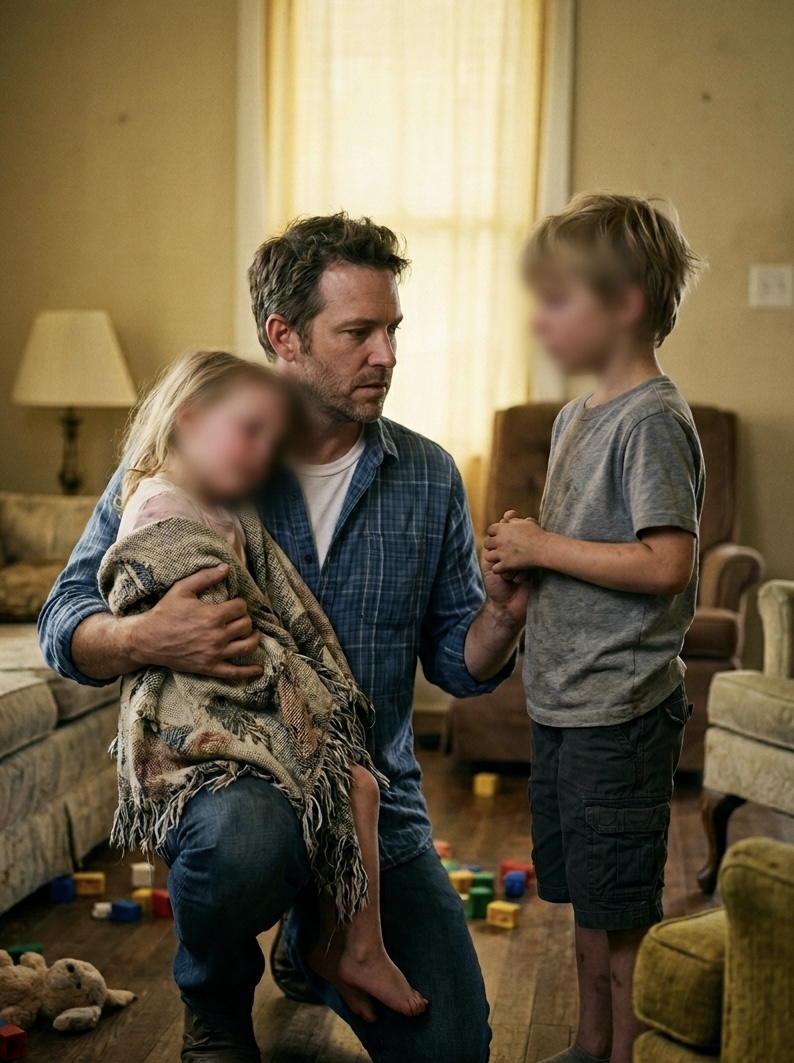
When Rowan returned to Elsie’s room, Micah was sitting beside the bed in a chair too large for him, watching his sister sleep with the grave, exhausted attention of someone who felt responsible for keeping the world from collapsing again.
“Dad?” he asked. “Can I stay with you all the time now?”
Rowan crouched beside him.
“Starting now, you stay with me as much as you need.”
They spent that night in the hospital. Micah eventually fell asleep on a foldout chair under a thin blanket, and Rowan sat between his children, listening to the rhythm of Elsie’s IV drip and the muffled sounds of nurses trading shifts just outside the door.
In the morning a pediatric therapist from the hospital met with him.
She spoke quietly, but there was no softness in the truth of what she was saying.
“Your son took on far too much responsibility.
He did something incredibly brave, but it also means he is likely carrying fear that does not belong to a child. Your daughter is likely to cling to him because he became her source of safety. We need to begin support now, not later.”
Rowan nodded, absorbing every word like instructions for survival.
“Tell me what they need.”
“Routine.
Predictability. Calm.
Honest explanations without adult details. No promises you can’t keep.”
That part landed hardest, because until that moment Rowan had thought love would be enough if he only gave enough of it, fast enough.
Now he understood that love had to look like breakfast on time, bedtime stories, laundry folded, medicine measured, and sitting on the floor at two in the morning when a six-year-old woke up crying.
When Elsie opened her eyes later that afternoon, weak and confused but clearly present, Micah burst into tears for the first time since Rowan had arrived at the house.
He climbed carefully onto the edge of the bed and whispered, “I missed you.”
Elsie reached for him with a tired little hand.
“I was sleepy.”
Rowan smoothed both their hair back and said, “You’re both safe now.”
The next day, after arranging for a trusted neighbor to sit with the children for two hours, Rowan drove to Nashville General to see Delaney.
She was sitting up in bed when he entered, her left arm in a cast, bruising along her cheekbone, hair tied back in a careless knot that made her look younger and more defeated than he remembered. For a long moment she did not meet his eyes.
Rowan stood at the foot of the bed.
“The kids are alive,” he said, and the sharpness in his own voice surprised him.
Delaney closed her eyes briefly. “I know.”
“What happened?”
Her answer came slowly, as if she had to drag each piece of it up through shame.
She had gone out with a man she had been seeing, expecting to be gone only a few hours, she said.
She had been overwhelmed, exhausted, desperate to feel like a person instead of a machine running on work and childcare and loneliness. Then there had been drinking, an argument in the car, a wreck, darkness, and after that nothing until she woke in the hospital.
When Rowan said, “You left a six-year-old and a three-year-old alone with almost no food,” there was nothing dramatic in his tone.
That was what made it harsher.
Tears slid down Delaney’s face, but he did not step closer.
“I know,” she whispered. “I know what I did.”
“Micah thought his sister might not make it through the night.”
Delaney covered her mouth with her good hand and bent forward.
Rowan let a long silence sit between them before he spoke again.
“I’m filing for full temporary custody.”
She looked up, broken and exhausted.
“Are you taking them away from me forever?”
He shook his head once. “I’m protecting them. What happens after that depends on what you do next.”
To her credit, she did not argue.
She did not accuse.
She did not reach for easy excuses. She only asked, after another long silence, “How are they?”
“Elsie is recovering.
Micah saved her by calling me.”
That sentence seemed to crush whatever was left of Delaney’s defenses. She cried quietly, without theatrics, and Rowan understood then that remorse was real even when it came too late to prevent harm.
Before he left, she said, “I’m starting therapy.
I already asked.”
He rested one hand on the doorframe.
“Good. Keep going.”
The first weeks at Rowan’s house were rough in ways he had never fully imagined. Micah woke from sleep calling for both parents at once.
Elsie refused to be in a room alone, even for a minute, and shadowed her brother so closely that Rowan sometimes found them both standing outside the bathroom door waiting for each other.
Rowan burned grilled cheese twice, shrank two sweaters in the wash, forgot a permission slip, and learned that a child can ask the same fearful question in ten different ways before bed.
But he stayed.
He packed lunches, sat through therapy sessions, left work early, turned down evening events, and began to build days sturdy enough for his children to lean against. Somewhere inside that exhausting routine he discovered that fatherhood, when stripped of every performance and reduced to what mattered, was not grand at all.
It was repetitive, humble, and holy in its own way.
Delaney, meanwhile, followed every requirement given to her. She attended therapy, cooperated with the court, found a small apartment of her own, ended contact with the man from the accident, and began supervised family visits at a county center with a therapist present.
At first the visits were painfully awkward.
Micah stood close but reserved.
Elsie hid behind him and studied Delaney as if trying to decide whether she was real.
Delaney did not force hugs or beg for forgiveness. She read books, colored quietly, brought old family photos, and showed up every single time.
That mattered.
Children notice consistency the way flowers notice light.
By early summer, the family court hearing arrived.
Rowan wore a navy suit and carried a file full of medical records, therapy notes, and social worker reports. Delaney sat across from him in a simple cream blouse, looking healthier than she had in months, though still cautious, as if she knew one wrong step could undo everything she had struggled to repair.
The judge reviewed the reports and listened to both attorneys.
Delaney’s counsel emphasized her progress, her treatment compliance, her housing, her sobriety, her commitment.
Rowan’s attorney detailed the original neglect and the children’s trauma but also acknowledged the visible improvement in supervised reunification.
When the judge asked Rowan directly for his position, he stood and answered without embellishment.
“My children need safety first. They also love their mother.
If the professionals believe gradual contact is healthy, I won’t stand in the way of that. I just need the pace to match what the kids can handle.”
The judge nodded.
A temporary plan was approved: continued primary placement with Rowan, progressive visitation with Delaney, close therapeutic oversight, and a review in three months.
Delaney turned to Rowan in the hallway afterward and said quietly, “Thank you for not making this uglier.”
He looked past her toward the waiting room where Micah sat drawing beside Elsie.
“This was never about winning.”
The changes came slowly, which was exactly why they lasted.
Saturday visits became weekday dinners.
Weekday dinners became afternoons at Delaney’s apartment with a therapist checking in. Delaney’s apartment was modest but warm, with a reading corner she made for Elsie and a shelf of card games Micah loved. She learned how to move gently, how to listen more than explain, how to let trust return on the children’s timeline rather than her own.
One evening, after a supervised visit at her place, Micah asked Rowan in the car, “Can Mom come to my school play if I want both of you there?”
Rowan glanced at him in the rearview mirror.
“Of course she can.”
Another night, Elsie climbed into Rowan’s lap with a drawing of two little houses joined by a rainbow.
“This is us,” she announced.
“We live in two places, but we go together.”
Rowan looked at the picture for a long time before saying, “Yeah, sweetheart. We do.”
Months later, at the final review hearing, the judge invited Micah and Elsie to speak for themselves in the simple, careful way family courts sometimes allow when children have been well prepared.
Micah said, “I like it when nobody fights and everybody tells the truth.”