I told my grandson’s class I helped my best friend die before I was old enough to buy a beer, and the room went so still it hurt.
Nobody laughed.
Nobody whispered.
Even the boy in the back who had been half asleep with his hood up lifted his head and looked at me like I had just kicked open a locked door.
My grandson, Ethan, sat in the second row.
His face had that worried look kids get when they’re scared the old man they love is about to embarrass them.
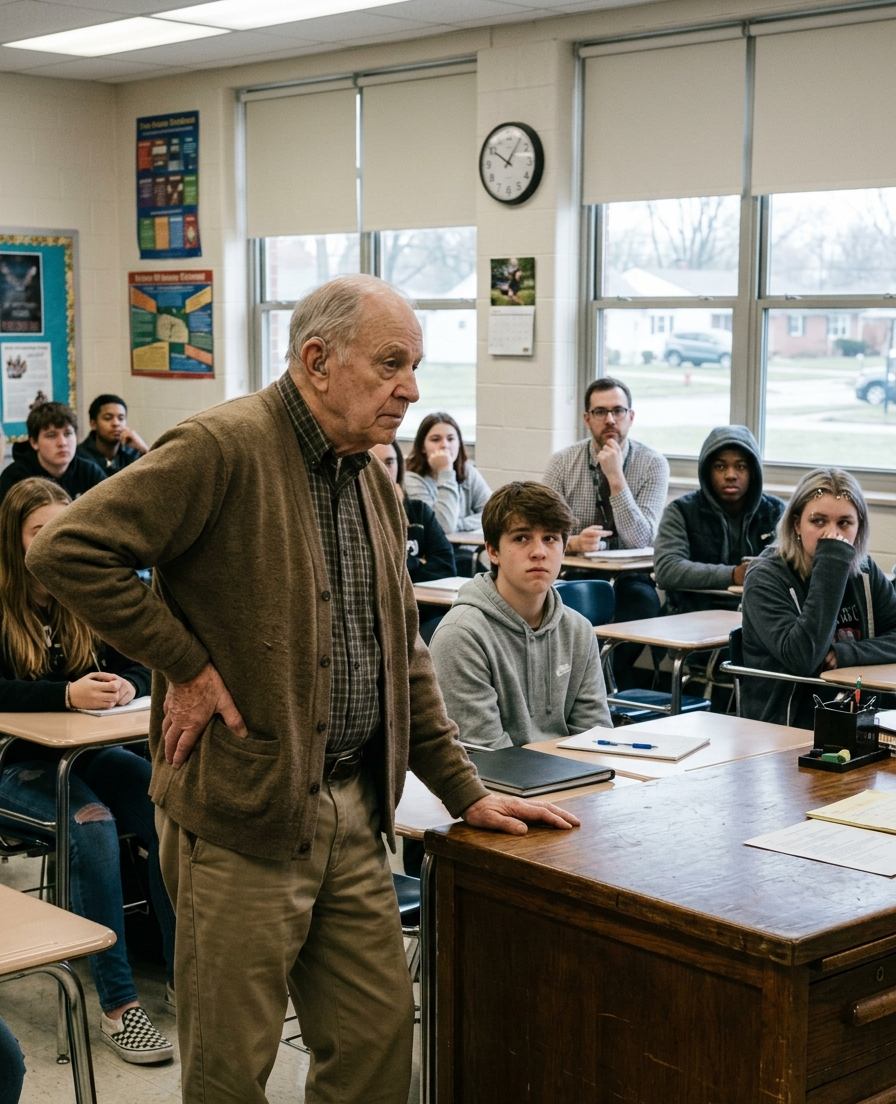
I was standing at the front of a public high school classroom in Ohio, one hand on the teacher’s desk, the other pressed against my bad hip.
The teacher had asked me to come in for “American Voices Week.”
Usually they got people who talked about starting businesses, building apps, or becoming internet-famous for doing almost nothing.
This year they got me.
A seventy-seven-year-old man with a limp, a hearing aid that whistled when it felt like it, and a dead friend still living in his chest.
I told them I hadn’t brought notes.
“You don’t need notes,” I said, “when the thing you remember never stopped happening.”
That got them.
Not because it was polished.
Because it was true.
I told them how I was drafted at nineteen.
How I didn’t go because I was brave, or noble, or wise enough to understand the speeches men made on television.
I went because a letter came in the mail, my mother cried in the kitchen, and three weeks later somebody was shaving my head while a stranger screamed in my face to forget the boy I used to be.
I told them fear has a smell.
It smells like sweat under thick fabric, dirt baked by heat, and metal so hot it seems alive in your hands.
I told them movies lie.
Most men do not die shouting.
Most men die confused.
Some die apologizing.
Some die asking for their mothers.
Then I told them about Danny Ruiz.
He was from El Paso.
Talked too much.
Laughed too loud.
Kept a photo of his little sister in his breast pocket and swore every week that when he got home he was going to open an auto shop and never let anybody boss him around again.
We made a promise.
If one of us went, the other one stayed.
Not forever.
Just long enough so nobody had to die alone.
One afternoon our patrol hit a buried explosive on a muddy trail.
The sound came first.
Then the dirt.
Then the silence that always comes after something terrible, like the world itself is waiting to see what you’ll do.
Danny took the blast.
Not all of it.
Just enough.
I got to him fast, but not fast enough.
He was bleeding in a way that made hope feel childish.
I pressed my hands where they told us to press.
I opened bandages with my teeth.
I kept saying, “Stay with me. Stay with me.”
He looked at me like he was already far away.
Then he said the one thing I have heard every night for fifty years.
“Tell my sister I was scared.”
Not “tell her I was brave.”
Not “tell her I fought hard.”
Just the truth.
I told the class that was the moment I became old, even though I was still a teenager.
A girl with silver rings in both eyebrows pulled her sleeve across her face.
A boy near the windows stared down at his desk so hard I thought he might crack it.
Then I told them the part nobody likes to hear.
Coming home was its own kind of loneliness.
At the airport in California, a young woman looked at my uniform and called me a monster.
Back in my hometown, people acted like I had brought the war home in my duffel bag.
My mother hugged me until she shook.
My father carried my suitcase inside and said, “Best keep quiet about all that.
Folks have strong feelings.”
So I did.
I kept quiet when I couldn’t sleep in a real bed.
I kept quiet when fireworks made me grab the arms of my chair.
I kept quiet when whiskey became easier than talking.
I kept quiet when my first marriage cracked under the weight of things I would not say out loud.
For forty years, I was the man at cookouts who smiled too fast and changed the subject.
The man people called strong because they never saw what happened after dark.
Then the boy with the hood asked me the question.
“Was it worth it?”
The room tightened.
That question was bigger than all of us.
I looked at him for a long time.
“I don’t think any war is worth what it takes from ordinary people,” I said. “Not from the ones who go.
Not from the ones who wait at home.”
Nobody moved.
“But I’ll tell you this,” I said. “Loving the man beside you enough to carry him when your own legs are shaking—that matters. Telling the truth when it would be easier to hide—that matters.
Coming home broken and still trying to be gentle—that matters.”
I tapped my chest.
“Pain can turn you hard. Or it can turn you honest. It took me a long time to choose.”
The bell rang.
Not one kid stood up.
The teacher actually looked at the clock like he didn’t trust it.
Then the chairs started scraping, slow and awkward, like nobody wanted to be the first person to break whatever had just happened in that room.
As they filed past me, most of them avoided the usual fake politeness.
They looked me in the eye.
One girl whispered, “My grandpa never talks either.”
A tall boy with shaky hands said, “My brother came back different.”
Then a quiet kid I had barely noticed slipped a folded note into my palm and walked out before I could stop him.
I opened it in the parking lot.
The handwriting leaned hard to the left.
It said, “Thank you for saying the parts men usually hide.”
That night Ethan sat beside me on the porch while the streetlights flickered on.
He didn’t look at his phone.
He just leaned his shoulder into mine and said, “I never knew you were lonely that whole time.”
Neither did I.
Not really.
I had called it pride.
I had called it toughness.
I had called it being a man.
But sitting there in the dark beside my grandson, with that note in my pocket and Danny’s last words still alive in my ears, I finally understood something simple.
Sometimes the bravest thing an old man can do is stop surviving long enough to be heard.