There is something quietly devastating about feeling alone in a room full of people celebrating love.
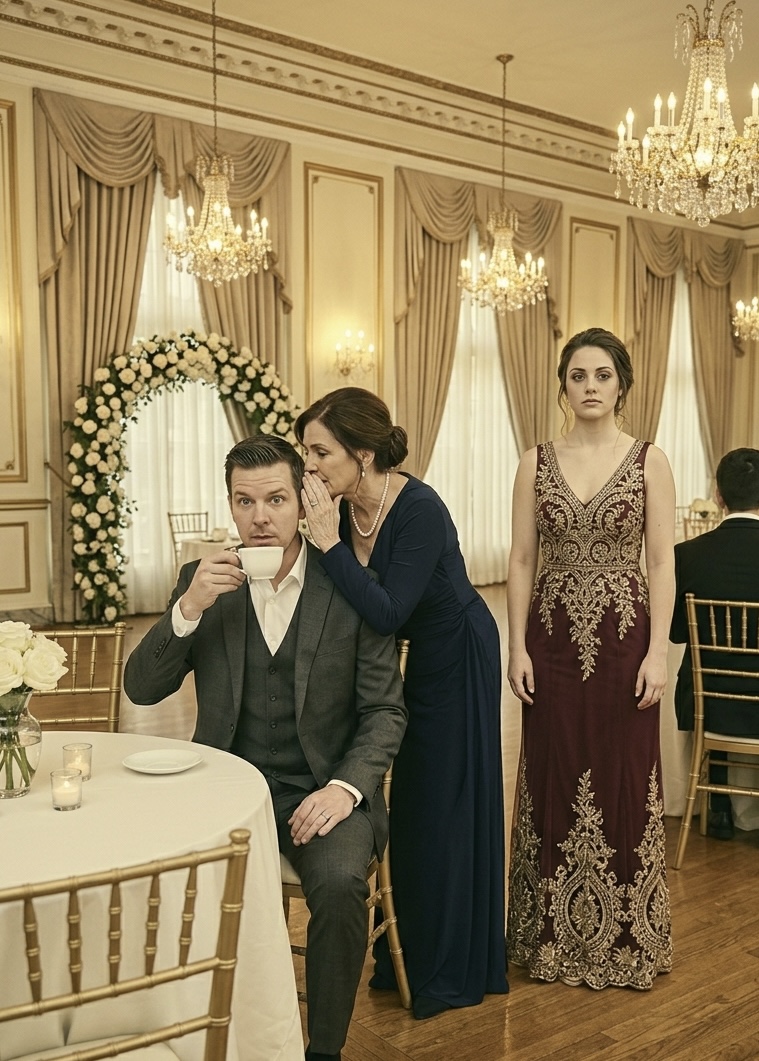
Marco Salazar had learned to carry that feeling like one carries an old scar: no longer with the raw pain of the first few days, but with a dull weariness that appeared when he least expected it. Like that afternoon, sitting at a round table near the tall windows of the Imperial Room, in an elegant hotel in downtown Mexico City, watching the arrangements of white flowers catch the golden light of the afternoon.
He held a teacup with both hands, just as his mother had taught him when he was seven. He was forty-one, though many guessed he was younger.
He wore a navy suit with the same care a man gives to donning armor: carefully, intentionally, hoping it would say something about who he wanted to be, and not just about who he was at that moment.
A single father.
A man whose wife had left three years earlier, on an ordinary Tuesday, leaving a handwritten note on the kitchen counter, and his six-year-old daughter, Lucia, sitting at the table drawing butterflies with crayons, unaware that his world had just changed forever.
Marco had been invited to the wedding by Daniel Ortega, an old college friend whose younger sister was getting married that afternoon. He had accepted because Lucía was spending the weekend with her grandmother and because his therapist—a soft-spoken woman who wore glasses dangling from a beaded chain—had gently told him that he needed to practice being in the world again.
So there I was. Practicing.
Couples arrived arm in arm around her.
Men in impeccable suits. Women in long dresses and expensive perfumes. Old friends meeting with hugs and laughter.
Under the warm light of the lamps, even strangers seemed beautiful and familiar.
Marco watched everything from his corner and felt the distance between him and that happiness as if it were an invisible pane of glass.
She glanced down at her phone, not because she was expecting a message, but because holding it gave her hands something to do. That’s when she heard the voice.
“Excuse me, young man,” said a woman from behind his left shoulder. “I’m going to ask you something very strange, and I need you to say yes before I explain why.”
She was a woman in her late sixties, maybe seventies.
Her silver hair was elegantly styled in an updo, and she wore a long-sleeved black lace dress and a simple pearl necklace. But that wasn’t what caught Marco’s attention. It was her eyes: warm, steady, full of the kind of serenity that only people who have survived too much to be afraid of everything possess.
“I don’t have much time,” she continued with calm precision.
“My name is Elena, and I need you to pretend for twenty minutes that you are my daughter’s fiancé.”
Marco blinked.
-Sorry?
“My daughter’s name is Valeria. She’s about to walk through that door. I’ll explain everything later, but right now I just need to make sure a woman doesn’t walk alone into a room where some miserable man intends to humiliate her.”
Marco looked at her in silence.
In another life, in the version of himself before that Tuesday with the note in the kitchen, he might have dismissed the idea with an awkward smile.
He would have invented some polite excuse and gone to the bathroom to hide.
But something in Elena’s face stopped him.
It wasn’t drama. It wasn’t madness. It was desperation dressed in dignity.
The expression of someone doing their best in the face of an impossible situation.
Marco moved the cup away.
—Sit down and explain it to me.
Elena exhaled barely, as if she had been holding her breath. She settled down beside him and spoke quickly, but clearly.
—My daughter is thirty-eight years old. She’s been engaged twice.
Both relationships ended the same way: men who initially admired her character and intelligence, but ultimately decided she was “too much woman” for them. Brilliant. Independent.
Uncomfortable for men who wanted someone smaller, easier to control.
He paused.
—Her father and I raised her this way on purpose. We never taught her to shrink herself to make others feel big.
Marco nodded, still not knowing why that story hurt him.
“Her father died four years ago,” Elena continued. “Pancreatic cancer.
It all happened so fast. And the last man she was engaged to, Jaime, contacted me months ago. He spoke of reconciliation, of repentance.
I agreed to see him today because I thought perhaps I had been unfair to him. But an hour ago, his sister, who actually has a heart, wrote to me to tell me the truth. Jaime didn’t come to reconcile.
He came to see her walk in alone. He’s been saying all over this social circle that Valeria ruined the relationship, that she was cold, difficult, arrogant. He wants people to see with their own eyes a woman abandoned and alone so that this image will confirm the story he made up.”
Her fingers tightened around the handbag.
—I’m not going to allow it.
Marco remained silent for a moment.
She thought of Lucía drawing butterflies, unaware that her mother was leaving.
She thought about how unfair it was that someone else decided what story the world told about your life.
—Where is your daughter now?
—In the hallway. She always takes three deep breaths before entering a place where she doesn’t want to be. She’s done it since she was a child.
Elena’s voice softened slightly.
—I just need it to be that when I go in, I see a different scene.
A different one. One where no one can turn it into a spectacle.
Marco took a deep breath.
“If we’re going to do this, I need to be able to talk to her like a real person. Tell me something about herself.”
Elena smiled for the first time, barely a hint of tenderness.
—He’s passionate about architecture.
He loves old movies. And he believes that good bookstores no longer exist.
—And something that only a mother would know?
Elena thought about it for a second.
—When she’s nervous, she touches the back of her left ear, as if checking that she still has the earring in.
Marco nodded.
-Good.
He settled into his chair and turned slightly toward the main entrance. He didn’t need to ask what Valeria looked like.
At that moment the doors to the hall opened.
The woman who entered wore a dark red dress, the color of deep red wine in the light.
Later, Marco wouldn’t be able to explain precisely what it was that had left him speechless at that first glance. It wasn’t just the dress, although it was beautiful. It wasn’t just her face, serene and clear, with that beauty that seems built on strength of character rather than vanity.
It was the way she walked.
Valeria walked like people who one day, after much pain, decided to stop apologizing for existing.
Straight back.
Chin up. Firm step.
But for a split second, as he scanned the room, Marco saw something else: the quick search for a friendly face and the intimate preparation for not finding it.
As if, of course, she were going to come in.
As if there was no other place in the room I wanted to look towards.
Valeria stopped.
She looked at Marco. Then at her mother.
Elena gave him a flawless smile and gently patted the empty chair next to them.
Valeria approached.
Marco stood up when he saw her arrive, without thinking twice.
He did it instinctively, like his father always did when his mother entered a room. An old, simple gesture that he had inherited without realizing it.
“You must be Marco,” she said.
Her voice was deeper than he had imagined, and completely firm.
—I’ve heard good things.
“I hope they haven’t exaggerated,” he replied.
Valeria gave a small smile and sat down. She looked at her mother with a questioning expression.
“You look beautiful,” Elena said naturally.
“Red was the right choice.”
—You yourself told me a thousand times that you never wear red at a wedding.
“Sometimes I make mistakes,” Elena replied. “It’s rare, but it happens.”
Marco felt something warm stir in his chest as he listened to that exchange. The intimacy between mothers and daughters.
Their shared history compressed into two sentences.
She served them more tea.
“My mother says you’ve been friends with Daniel since college,” Valeria remarked.
“For far too many years,” Marco replied. “She’s one of the few people who at forty is still essentially the same as she was at twenty-two. And I find that reassuring.”
Valeria bowed her head.
—Does consistency reassure you?