I bought new boots for the old janitor at my school after weeks of watching him work in ones held together with tape. I thought I was doing something kind. I had no idea those boots meant something I wasn’t supposed to touch until he showed up at my door that night.
I’ve taught second grade for six years.
Every morning starts with hallway noise, pencil drama, and somebody calling, “Miss Angie, he took my eraser.”
In the middle of all that, our school janitor, Harris, always moved through the building like steady background music. The kids never forgot him. They loved him in that open way children love anyone gentle.
Harris tied loose shoelaces, found runaway crayons, and fixed chair legs before somebody tipped sideways.
He never acted put-upon. He just nodded, knelt, repaired, cleaned, and kept moving.
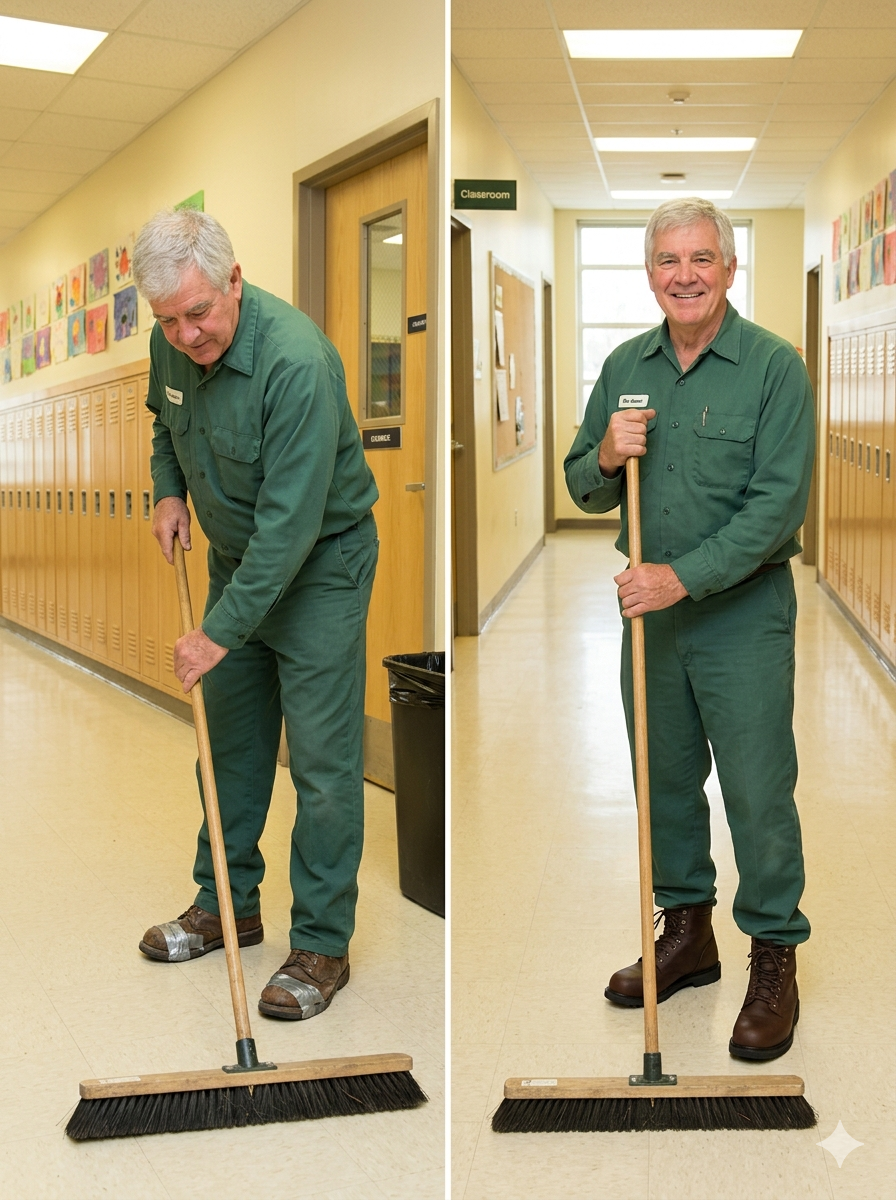
That was why his old boots started to bother me. They were old brown work boots with silver tape wound around the soles in thick bands.
Not one strip. Layers. The leather was cracked, and on rainy mornings, the tape looked dark and soggy by first recess.
I told myself maybe Harris was waiting for payday.
Then another week passed.
Then another. The tape stayed.
Wanting to help was easy. Finding a way that wouldn’t shame Harris was harder.
That Friday, while my class worked through their assignments, I called Mia to my desk.
Eight-year-old Mia was fearless, curly-haired, and thrilled by any task that sounded even slightly official.
“Mia, can you do me a favor?”
She leaned in. “A real favor, Miss Angie?”
She grinned and skipped off. From the doorway, I watched Mia walk right up to Harris near the water fountain.
“Mr.
Harris, what size shoes do you wear?”
He looked down at Mia, broom paused in one hand, then smiled, amused.
“Oh yeah? What do you need that for?”
Mia shrugged. “I think my dad wears the same size.
I just wanted to check.”
“Size eleven,” Harris said. “And still holding on somehow.”
Mia laughed and ran back. Something in the way Harris said it made me feel as though those boots carried a story.
That weekend, I drove to a workwear store across town and bought the best pair I could afford without getting flashy about it.
Thick sole, warm lining, and sturdy leather.
At home, I wrote a note on lined paper: “For everything you do, Mr. Harris. Thank you.”
No name.
No fuss. I wanted kindness to land softly, not loudly.
***
Monday morning, I slipped into the janitor’s closet before the halls filled up and set the box in Harris’s cubby with the note tucked under the lid.
My heart was thumping as if I’d done something wild, when really all I’d done was buy a man decent boots.
I thought that would be the end of it, and that was my first mistake.
That night, rain slammed against my windows while I sat grading spelling quizzes. My husband, Dan, was overseas on a work trip, so the house felt extra hollow.
At 9:03 p.m., somebody knocked.
I opened the door and there was Harris.
He was soaked through, cap dripping, jacket dark with rain.
The shoebox was tucked under his coat inside a plastic grocery bag, protected better than he was.
“I kept them dry, Miss Angela,” he said. “But I can’t accept them.”
“Harris, come inside.”
He hesitated. I stepped back and held the door wider.
After a beat, he came in.
I settled Harris near the fireplace with a towel and coffee. He wrapped both hands around the mug without drinking. The shoebox sat in his lap like something alive.
“How did you know it was me?” I asked.
“I saw you put it in my cubby while I was sweeping by the lockers.” Harris paused.
“I knew you meant well.”
His fingers tightened on the cup as his voice softened. “Some things aren’t mine to replace, Miss Angela.”
“They’re just boots, Harris. I thought you might need a new pair.”
Harris’s eyes lifted to mine, shiny and tired.
“No, ma’am. Not these.”
I knew then that had very little to do with money or pride.
“Help me understand,” I urged, softer.
Harris shook his head.
“Some things are better not known, Miss Angela.”
Rain rattled my windows. The fire popped. Harris set the coffee down untouched and stood.
“I need to head home.
My wife is waiting for me.”
That sentence should’ve been ordinary. But the way Harris said it sent a chill running down my spine.
I grabbed the umbrella from the stand by the door. “Then take this at least.”
Harris accepted it with both hands.
Then he looked at me, and a strange softness came over his face.
Before I could ask what that meant, Harris opened the door and stepped into the rain. I stood there in my socks, watching his figure disappear under the streetlight.
Dan called from London around midnight. I told him everything.
“Maybe he just doesn’t like help, Angie,” he said.
“It wasn’t that, Dan.”
“Then maybe the old boots meant something,” Dan added.
“Try not to spiral.”
I said goodnight and lay awake replaying every second.
Harris wasn’t at school the next day. In six years I had never come in and not seen him somewhere before lunch. By noon, I asked the office.
Mrs.
Cole lowered her voice. “He’s home sick. Took the whole week.”
I waited until dismissal, got Harris’s address under the excuse of dropping off a card, then drove to a narrow street on the edge of town with bread, soup, fruit, and tea on the passenger seat.
His house was small and weathered, with peeling white trim and a porch that leaned just a little.
I knocked. The door eased inward on its own.
“Harris?” I called.
No answer. Then, faintly from upstairs, a cough.
I stepped inside thinking I was checking on a sick man, and instead I walked straight into my own childhood.
The first thing I noticed was the smell.
Old wood, furniture polish, and… marigolds.
It hit me like a hand to the chest because I knew that smell from somewhere deep and old. Then I turned toward the staircase and saw the framed photo on a table below it.
A woman’s face.
Candles. And fresh marigolds in a jar.
Recognition didn’t come in pieces. It came all at once.
“Catherine,” I whispered.
Catherine from Willow Lane.
The woman who brought soup when I was eight and down with pneumonia, who had a warm laugh and yellow curtains in her kitchen.
How was her picture in Harris’s house?
I gripped the railing and climbed. By the time I reached the bedroom door, my heart already knew the answer my mind was still chasing.
Harris was propped against the headboard under a quilt, cheeks flushed with fever. He looked startled.
I set the grocery bag on a chair and cut straight to it.
“Why is Catherine’s picture downstairs?”
The room went still after that, as if even the air was waiting on him.
Harris looked toward the window, then back at me.
His eyes filled up before he even spoke.
I sat down because my legs stopped feeling reliable. My eyes went to the shoebox on the floor by the dresser.
“Those boots were the last pair Catherine bought me,” Harris recounted. “Five years ago.
She made me try on three pairs because she said I was too cheap for my own good.”
A little wet laugh escaped me.
“I kept taping them because they were the last things she picked out for me.” Harris looked down at his hands. “The tape wasn’t just tape to me. It felt like I was still walking in something my Cathy chose.”
That was the moment the old boots stopped being sad and became sacred.
I cried then, quiet at first, then not quiet at all.
Harris offered me a handkerchief from the nightstand with a gentleness that nearly finished me off.
“Catherine never forgot the little girl on Willow Lane,” he said.
I froze. “She remembered me?”
Harris smiled faintly. “Of course.
How could she forget the little one who brought her marigolds every day?”
Just like that, the years between us cracked open.
“You knew me?” I pressed.
Harris nodded toward the cedar chest at the end of the bed. “Open the top drawer.”
Inside, wrapped in tissue, was a tiny doll made from candy wrappers, with twisted silver arms and a pink skirt.
“I made this,” I breathed.
Harris gave a faint, sad smile, as if he’d been waiting years for that moment. “You gave it to Catherine the day your aunt and uncle took you away.”
The room blurred.