I almost didn’t write this down. My therapist said it might help, and my eight-year-old daughter keeps asking why I smile at strangers now in a way I didn’t used to. So here it is. The story of how my mother-in-law tried to break me on my wedding day, and how a single overheard sentence ended up rewriting both our lives.
My name is Kathy. I’m 33. Until last spring, the most romantic thing in my life was the moment my daughter Emma first slept through the night. After her father walked out when she was two, I worked double shifts at a hospital cafeteria and went to nursing school online. I learned to live on toast crusts and library Wi-Fi. I learned to never expect rescue.
Then I met David.
David was a quiet man who fixed the printer at the clinic where I did my clinical rotations. He brought Emma a stuffed dinosaur on our second date, before he’d even kissed me. By our sixth month, Emma had stopped flinching when men raised their voices on television. By our first anniversary, she called him “my David” like he was a possession she’d earned through good behavior. He proposed under the oak tree in his parents’ backyard, with Emma hiding behind a planter holding the ring box.
I should have known. Beneath every story like mine, there’s always someone who hates the ending before it begins.
That someone was Linda.
Linda is David’s mother. She’s 62, has a standing Thursday appointment at a salon in Highland Park, and refers to her bridge club friends as “the ladies” the way Catholics refer to the saints. The first time I met her, she looked at Emma’s secondhand shoes and said, “How resourceful.” She said it the way you’d say “how brave” to someone with a terminal illness.
I told myself she’d warm up. People always told me to give it time.
Three months before the wedding, Linda took me to lunch and slid a thick envelope across the table. “Just some practical paperwork, sweetheart. Emergency contacts, beneficiary updates. David’s so scatterbrained about these things.” She tapped the manila folder with a freshly painted nail. “It’s just paperwork. Sign where the flags are.”
I signed. I’m a nurse. I sign forty things a day without reading them. And she was finally being nice to me.
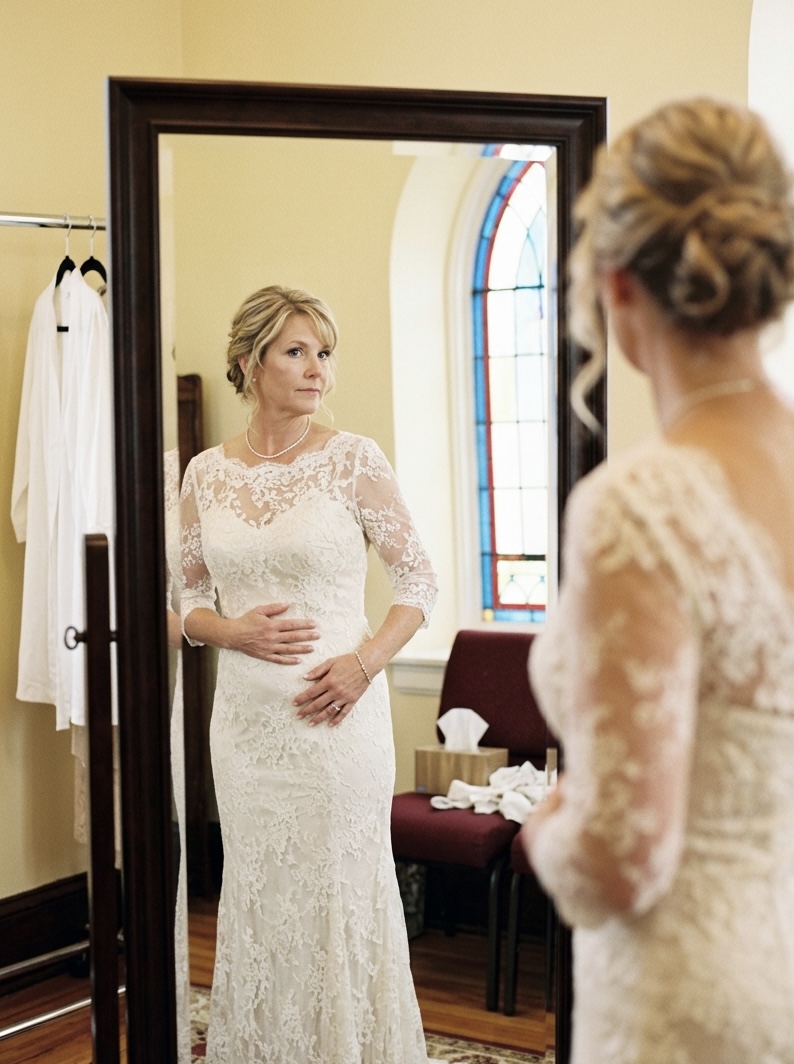
On the morning of my wedding, I walked into the bridal suite and saw Linda standing at the full-length mirror in a floor-length white lace gown with a beaded train. Sequins caught the light from the stained-glass windows. For a full ten seconds I genuinely thought I was hallucinating.
She turned, smoothed the fabric over her hips, and said, with a smile that didn’t reach her eyes:
“I suppose we should start planning the next wedding now.”
My maid of honor, Tasha, made a sound behind me like a kettle starting to whistle. I put a hand on her wrist before she could say anything.
Linda crossed the room and pressed a small envelope into my palm. “For your honeymoon, dear.”
Inside was exactly $154 in cash. Two twenties, six tens, ten fives, and forty-four ones. I counted it later, in the bathroom, with my veil hooked on the towel bar. I’d already booked our honeymoon — a week in Galveston that David had paid for in January. I didn’t understand what the money was for until that afternoon, when I idly typed the number into my phone.
$154 was the exact price of a one-way Greyhound ticket from Dallas to my hometown in Ohio.
I almost laughed. I genuinely almost laughed in the back of the church, my dress half-zipped, a nine-year-old flower girl tugging on my sleeve asking when we were going to “do the walking part.”
I walked down the aisle anyway. David didn’t notice his mother’s dress. He has the kind of focus that makes him a good engineer and a terrible witness. But his aunts noticed. His father noticed. Halfway through our vows, my new father-in-law actually whispered “Jesus, Linda” loud enough that the videographer caught it.
I said “I do.” I meant it. I held David’s hand all through the reception and pretended I didn’t know that my mother-in-law had brought bus money to my wedding as a hint.
Two weeks later, I was unpacking the last of our gift boxes in the kitchen when I heard Linda’s voice. She’d let herself in with the key David had given her “for emergencies.” She was leaning against the counter, scrolling her phone, the kettle whistling beside her like nobody had ever told her how to turn off a stove.
“One month, maximum,” she was saying. “Young single mothers looking for financial security always show their true colors eventually. I put my money on three weeks, but Margaret thinks I’m being optimistic.”
I stopped in the hallway. I held my breath so hard my ears rang.
“Oh, it’s just a dollar bet between the ladies at bridge club.” Linda laughed — a light, social laugh, the kind you use at a charity auction. “But I’ve been watching her since David brought her home. The way she calculated the cost of everything at dinner. How quickly she moved in here. Some people just know how to spot an opportunity, Carol. Honestly, I almost admire it.”
A dollar.
She had bet one dollar that I was a gold-digger. She had stood in my wedding dress — in white, in a church, on the most important morning of my daughter’s life — because the ladies at bridge club had a pool on how long it would take me to fail.
I went into the bedroom. I sat on the edge of our bed for a long time. Then I opened the dresser drawer where David kept his important papers, and I pulled out the business card of the family attorney, Robert Chen.
Mr. Chen had been David’s grandmother’s lawyer first. He had a corner office downtown with a window that looked at another window, and a habit of pushing his glasses up his nose with one knuckle when he was thinking.
“I need to understand the financial arrangements,” I told him. “Specifically, who has access to what accounts. And what exactly I signed three months ago at lunch with Linda.”
He typed for a minute. He scrolled. Then he stopped scrolling.
“Mrs. Patterson,” he said carefully, “did Linda discuss the trust stipulations with you? The ones that transferred oversight to your name after the marriage?”
I felt the blood leave my face the way water leaves a tub. “What trust?”
He turned the monitor toward me.
David’s grandmother — a woman I had never met, who died when David was nineteen — had left an estate that was, to put it in technical legal terms, significant. She had structured it so that Linda would manage the assets only until David married. Upon his marriage, oversight transferred not to David, but to his spouse. Specifically to prevent, in the grandmother’s own written words, “the kind of interference Linda has historically demonstrated toward her son’s autonomy.”
The grandmother knew. Fifteen years ago, that woman had sat in this office and built a trap with my name on it, and she hadn’t even known what my name was going to be.
The paperwork Linda had me sign three months ago wasn’t beneficiary updates. It was the activation of my trustee oversight. She thought she was using me as a rubber stamp. She hadn’t read the fine print either.
“There’s something else,” Mr. Chen said. He pushed his glasses up. “The bank flagged some account activity last quarter. As trustee, you now have the right — and frankly the obligation — to request a forensic audit of the past fifteen years of Linda’s management.”
I asked him to make the call.
Three days later, Linda stood in our living room holding a letter from the bank. Her hand was shaking so badly the paper made a sound like a small animal trying to escape.
“This has to be some kind of mistake,” she said. “I’ve been managing David’s inheritance for fifteen years.”
David sat next to me on the couch. Mr. Chen had spent an hour at our kitchen table the night before, walking him through it. David had cried, briefly and quietly, and then he had eaten a sandwich and asked me if I wanted tea. That’s the kind of man he is. He grieves on a schedule and asks if you want tea.
I watched Linda set the bank notice down. Outside the window, a mockingbird was weaving twigs into a nest in the oak tree where David had proposed.
“One dollar,” I said.
Her eyes snapped to mine.