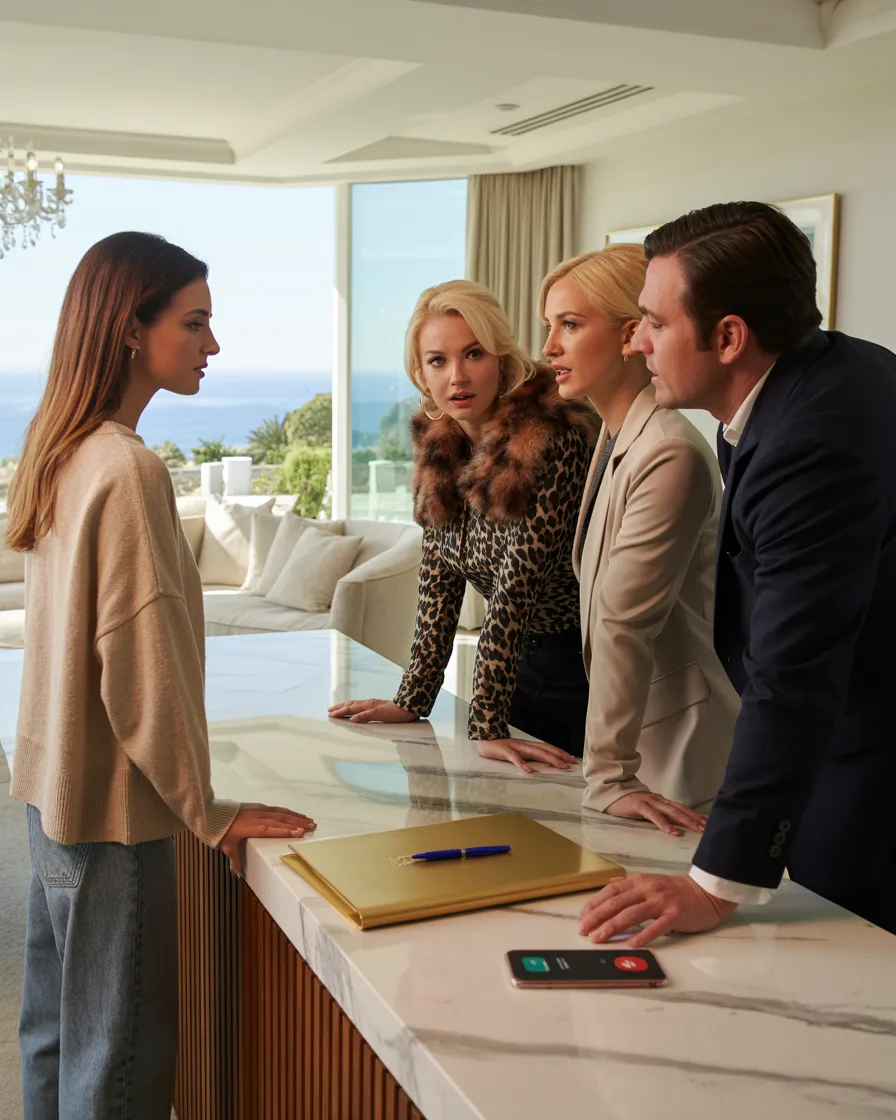
The night before my eighteenth birthday, I sat alone in a guest room near the laundry and watched a clock. Not with fear. Not anymore.
With the particular stillness of someone who has been waiting a long time for a specific moment and can finally see it from close enough to count the minutes. My name is Margot Paul. I am twenty years old now, and I want to tell you this story from the beginning, because the beginning is not the midnight transfer.
The beginning is much earlier, and it matters more than any document I ever signed. The beginning is my father. His name was David Paul.
He built a software infrastructure company in Silicon Valley over fifteen years starting from a two-bedroom apartment in Sunnyvale with a whiteboard, a partner who later left, and a particular talent for solving problems that other people considered unsolvable. He sold the company when I was nine for enough money that the number loses meaning if you stare at it too long. He died of a brain aneurysm when I was fourteen, sudden and complete and without warning, on a Tuesday morning in November when I was in third-period history class and knew nothing about it until the school counselor appeared in the doorway.
He was forty-seven years old. He had brown eyes and a loud laugh and he smelled like coffee and the specific cedar soap he had used my entire life and he called me Starling because when I was two I had apparently made a sound that reminded him of a bird he could not quite identify. I never asked him to explain the name further because some things are better left as gifts you do not unwrap all the way.
He told me, six weeks before he died, to pay attention. We were driving back from a business lunch he had brought me to because he believed that children should see how the world worked rather than be protected from it, and he was explaining something about a contract negotiation that had gone sideways. Pay attention, Starling.
To documents. To people. To what they say and what they don’t say.
The truth is always there if you look. I looked. It took four years of looking before I fully understood what I was seeing.
My mother’s name is Catherine. She had been beautiful and charming and strategic when she married my father, and she remained all three of those things after he died, redirecting those qualities toward the project of maintaining the life his money had made possible. She married Richard Holloway fourteen months after the funeral, which I understood intellectually as the right of any adult and felt emotionally as something I was not permitted to name out loud.
Richard brought to the marriage a struggling tech consultancy, a talent for presenting himself as more successful than he was, and a daughter from his first marriage named Serena, who was two years older than me and had the particular quality of someone who had been told she was exceptional for so long that she had stopped being able to see herself any other way. The Pacific Palisades house was mine only in the sense that I lived in it. Serena had the primary guest suite, the one with the ocean view, because she needed the better light for her content.
I had the room near the laundry area, which was given to me without ceremony on the grounds that I was, as my mother put it, less high-maintenance, which was true and was meant as a compliment and landed as neither. I had learned early that the household operated on a clear hierarchy and that I occupied a specific position in it, which was useful when they needed me to be invisible and slightly annoying when I had needs that required attention. I had adjusted to this the way people adjust to chronic conditions, not with acceptance exactly, but with the practical management of someone who understands that the condition is not temporary and that waiting for it to resolve itself is not a strategy.
I studied data science at UCLA. My grades were high. I kept them high not to impress anyone in that house but because I had understood from a young age that competence was the most portable form of independence, that knowledge could not be taken out of the structure my father had set up and redirected toward someone else’s Porsche.
Nobody in the house paid close attention to my studies. Serena’s Instagram engagement numbers received more dinner-table discussion than my academic performance. I did not hold this against them personally.
I held it as information. Two weeks before my birthday, my mother canceled the dinner I had requested. Not because of an emergency, not because of a conflict that couldn’t be avoided, but because Serena needed the main floor and terrace for a skincare brand launch mixer.
The conversation was brief. My mother praised me for being flexible and practical. Serena glanced up from her phone long enough to thank me.
I smiled and went back to my room and sat on the edge of my bed and counted to ten, which was a habit I had developed in the years after my father died as a way of putting a small space between what I felt and what I did next. I had learned that crying in that house gave them information they could use. Then I went back to studying.
The discovery happened on a Wednesday in October, three weeks before my birthday. I came home from campus early because a seminar had been canceled and the house was empty except for the particular hum of large air conditioning in a large house and the faint perfume my mother wore that seemed to absorb into every room regardless of whether she was currently in it. My stepfather’s iPad was on the kitchen island, which was not unusual.
What was unusual was the notification visible on its screen, a preview from an estate attorney whose name I did not recognize, with a subject line that contained my father’s name. I stood looking at it for approximately thirty seconds. Then I picked it up.
The document was forty-two pages of precise legal language that I read with the complete attention of someone who had been told, at twelve, to pay attention to documents. I read it standing at the kitchen island, not moving, the house entirely quiet around me. By the time I finished, I understood several things.
I understood that the Paul Family Capital LLC was designed to transfer eighty percent of my inheritance into a structure controlled by Richard as managing partner with my mother as co-trustee. I understood that Serena’s skincare brand was scheduled to receive eight million dollars in initial funding from this structure. I understood that Richard’s consulting business was scheduled to receive twelve million dollars as a capital injection.
I understood that the remaining twenty percent of my inheritance would be placed in a managed account for my education and living expenses that required their approval for any withdrawal over fifty thousand dollars. I understood that this document had been drafted and was in the process of being finalized and that nobody had mentioned it to me. I took out my phone and photographed every page.
Then I set the iPad back exactly where I had found it, took a glass of water from the cabinet, and went upstairs to my room, where I sat at my desk and opened a drawer that had been waiting for four years to be opened. In the drawer was a small business card. My father had pressed it into my hand the last time I saw him well, two days before the aneurysm, when I visited his office after school and he had been wrapping up for the day, in the particular mood he got sometimes when he was satisfied with the work of the week and had enough space to be present without an agenda.
He had taken a card from his desk and placed it in my palm and closed my fingers around it. If anything happens to me, he had said, Elias will take care of you. Trust him.
I had kept the card in that drawer for four years because my father had asked me to and because I had understood even at fourteen that some things you hold onto even when you do not yet know what they are for. I called the number the next morning. Elias Thorne’s office was in Santa Monica, three floors above a coffee shop that smelled like dark roast and the specific tranquility of places that take their coffee seriously.