For three years, I wasn’t just a chef; I was the structural integrity of my father’s steakhouse. I did the work that didn’t appear on the menu—the grueling, invisible labor of rebuilding a failing business. I redesigned the menu to focus on seasonal precision, I negotiated contracts with local farmers that slashed our food costs by 15%, and I personally trained the line cooks to handle the dinner rush with surgical accuracy.
My father, however, saw the restaurant as a theatrical production. He understood that fine dining is about perception, and in his vision of the show, I was the stagehand. My younger sister, Vanessa, was the “face”—polished, effortless, and entirely decorative. She could charm a table of investors, but she couldn’t tell you the difference between a reduction and an emulsion.
Dad loved that. He thrived on the illusion. To him, the restaurant wasn’t a business; it was a legacy that required a “softer face” to succeed. It didn’t matter that the halibut was mine, or that the brown butter carrots were the result of six months of testing. I belonged backstage.
The turning point was the night the lead investor, Ethan Cole, came for a private dinner to finalize a five-million-dollar funding package. My father had spent months keeping me away from Ethan. Every time Ethan asked to speak with “the chef behind the concept,” my father would brush him off with a laugh, gesturing toward Vanessa.
That night, the kitchen was a pressure cooker of tension. I watched through the service window as Vanessa stood at the head table in a silk dress, laughing at a joke she didn’t fully understand, accepting compliments for a menu she hadn’t touched. I heard my father telling the table, “This whole vision has been a family effort.”
It was his favorite way of erasing me without technically lying.
Around me, my sous-chef, Marcus, and the rest of the crew were working in silence. They knew the truth. They saw the burn marks on my forearms, the late-night inventory sheets I’d spent hours perfecting, and the way my father avoided my eyes. I felt a strange, cold detachment settling over me—the feeling of a building that has been structurally compromised for too long, finally reaching its breaking point.
When Dad leaned close to whisper, “Don’t make this night about you,” the last bolt holding me in place snapped. I didn’t yell. I didn’t throw a pan. I untied my apron with the methodical discipline of a surgeon finishing an operation.
“I’m done,” I said. The kitchen went deathly silent. I walked out the back door, the cool night air hitting my face like a reset button.
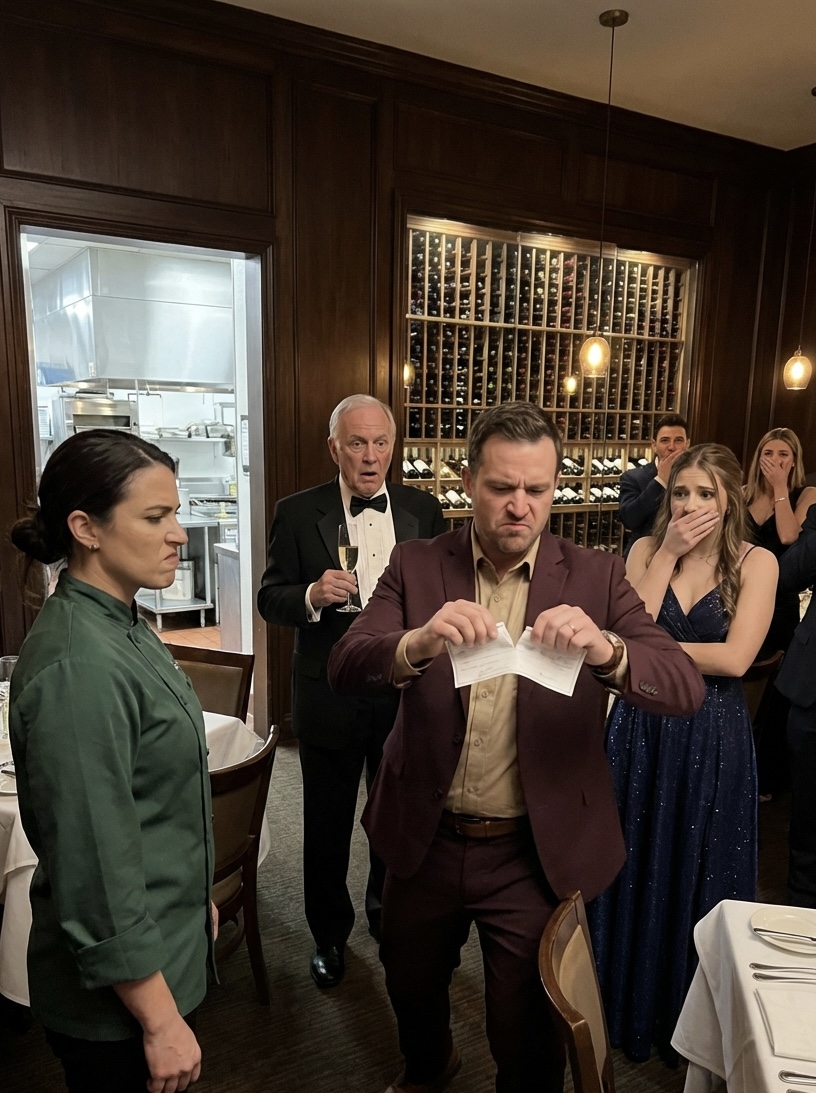
I was only three blocks away when the chaos began. Marcus called first, his voice shaking. “Claire, Ethan just stood up in the dining room. He told everyone the chef he came to fund just quit. He tore up the check and walked out.”
The theater had collapsed because the lead actor forgot that the audience was actually there for the food.
The next morning, Ethan Cole met me in a downtown coffee shop. He wasn’t there for a PR stunt; he was there for a strategy meeting. He laid out a roadmap: five million in funding, complete operational autonomy, and a site for a new location. But the conditions were non-negotiable. “I won’t fund your father,” he said. “I’ll fund you. But that means a clean structure. Your own company. Your own control. If you want it.”
Taking that offer felt like stepping off a cliff. It didn’t just mean leaving the family business; it meant competing against it. It meant that every reservation I took, every critic I won over, and every dollar I earned would be a direct strike against the man who had tried to erase me.
Dad found out by noon. The phone calls were a blur of threats, pathetic guilt-trips, and desperate bargaining. He claimed I was “tearing the family apart.” He claimed Vanessa was devastated. He claimed that he had “sacrificed everything” to give me a career. He used every emotional weapon he had, but he missed the one thing that mattered: I didn’t need his career anymore. I had the skills to build my own.
I chose a former bakery on the east side for the new location. I named it First Cut.
Building First Cut was a masterclass in stripping away the “theater.” We painted the walls a stark, professional gray. We installed a thirty-seat open kitchen. I wanted nowhere for the labor to hide. If I was searing the steak, I wanted the guest to see the sear. If I was plating the halibut, I wanted them to see the precision.
When we opened, the local media tried to frame it as a “family feud.” I refused every interview that asked about my father. I spoke only about the menu, the sourcing, and the labor. I spoke like a business owner, not a daughter.
Two months in, the critic from the Chicago Tribune reviewed us. He called the experience “one of the most confident new restaurants in Chicago,” specifically citing the “clarity of vision.”
That review was the final audit of my father’s business model. It proved that the theater was a distraction; the food was the business.
My father didn’t come to First Cut for a long time. When he finally did, it wasn’t to apologize—it was to see how I was surviving without him. He walked in, looked at the busy dining room, and saw a reality he couldn’t manipulate. He saw that I hadn’t been “difficult” or “dramatic”—I had simply been a professional waiting for a space that allowed me to be one.
I didn’t offer him the “best table.” I sat him at a standard two-top, served him the same food as everyone else, and then I went back to the line.
I’ve learned that families are not undone by change; they are undone by the lies they tell themselves to keep the status quo. My father thought he was the director of my life. He didn’t realize that I was the one who owned the building.