For the better part of a decade, I operated under a fundamental misconception: I believed that if I built a life that looked right, it would be right. I was the wife of a dependable man, the daughter of a pillar-of-the-community father, and the gatekeeper of a household that appeared perfect from the outside. But a life built on assumption is just a house with a cracked foundation.
You don’t find the cracks by looking at the paint; you find them by conducting an audit of the truth.
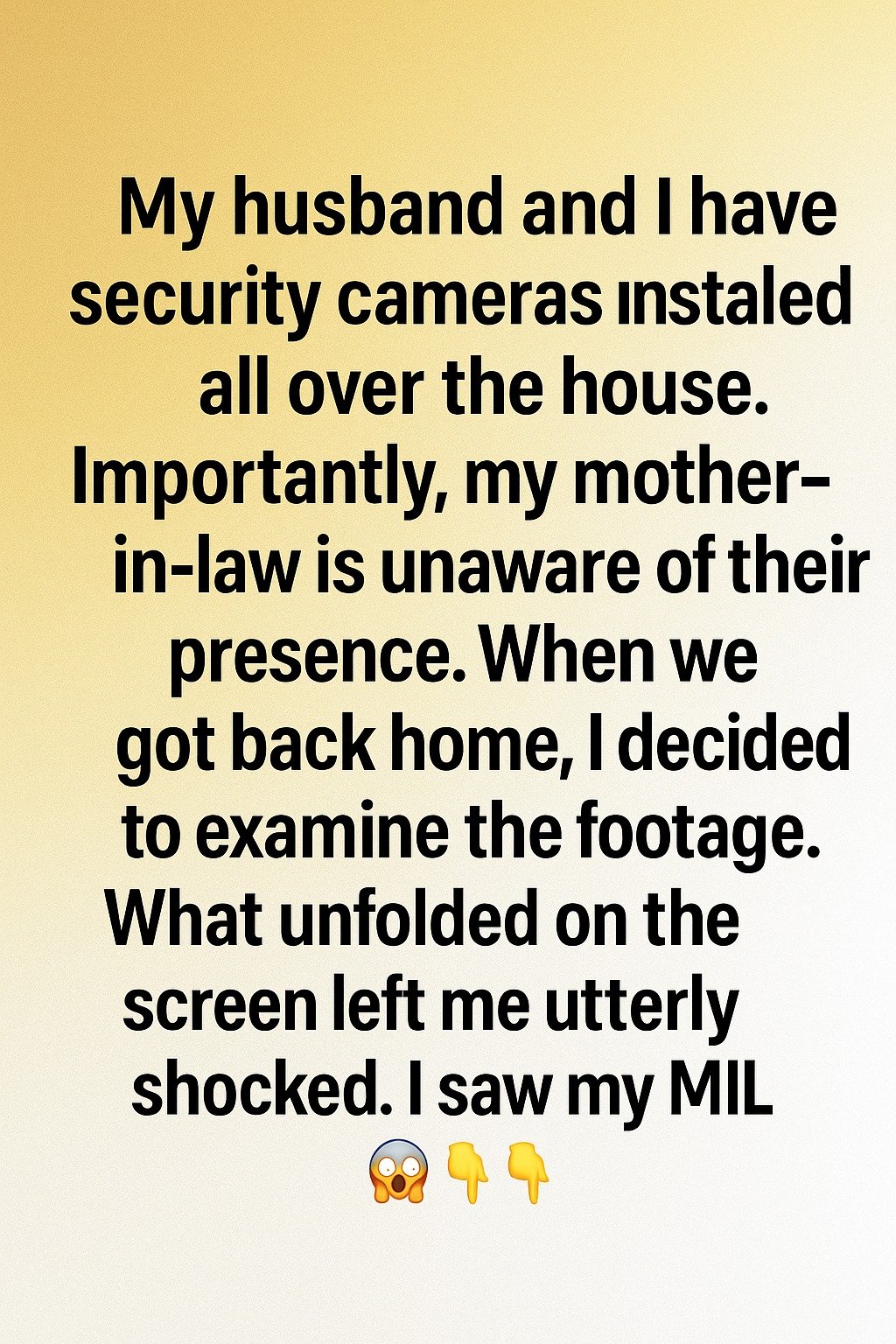
We installed security cameras throughout our home not because we were paranoid, but because we valued the integrity of our space. We never told my mother-in-law about them; it wasn’t a matter of trust—it was a matter of privacy. We assumed that if you are a guest in someone’s home, you behave as if the owners are present.
When we returned from a weekend trip, the air in the house felt heavy. The way she greeted us was “off”—a slight tremor in her voice, a shift in her posture. Curiosity, as it turns out, is a powerful investigative tool. I checked the footage.
What I saw wasn’t a crime; it was an invasion of essence. She wasn’t stealing silver; she was auditing us. She went through personal drawers, checked inside closets, and moved through our most intimate spaces with the entitlement of a landlord. She didn’t mean “harm,” but she was acting as if our privacy was negotiable.
I didn’t react with the “family drama” expected of a daughter-in-law. I sat with my husband and we conducted a calm, surgical analysis of the footage. We didn’t look at it through the lens of anger, but through the lens of contractual boundaries. The next day, we sat her down for coffee. We didn’t apologize. We didn’t make excuses. We stated the terms of the lease: We value your presence, but we require our privacy to be a non-negotiable term of your stay.
The result? She was embarrassed, yes. But it opened a door we didn’t know was closed. It transformed a relationship based on “assuming everything was fine” into one based on “respecting the boundaries.” Sometimes, the truth on camera doesn’t reveal a villain; it reveals an opportunity to grow.
That same clarity—that same need to audit the truth—is what saved me when my son, Caleb, disappeared into the nightmare of a step-parent’s betrayal.
I thought I knew my husband, Travis. He was the picture of “dependable.” But while I was away on a business trip, I came home to a catastrophe. My 17-year-old son, Caleb, wasn’t home. He wasn’t at a friend’s. I found him near a convenience store—tired, thin, wearing a torn backpack, looking like he’d been through a war.
Travis had sent him away. He had staged parties, lied to me, and systematically dismantled my son’s sense of security while I was out earning a living. He had tried to turn my own home into a site of exclusion.
In that moment, any trust I had for Travis evaporated. I didn’t cry. I didn’t beg for reconciliation. I realized that my husband was a man who performed the role of “provider” while actively destroying the most important person in my life.
I became the Architect of the Exit.
I worked with a trusted friend to stage a call. I forced Travis into a corner where his own ego would lead him to confess. He didn’t just reveal his guilt; he revealed his total lack of compassion. It was the best ROI I’d ever received on a conversation. I filed for divorce the next morning, moved Caleb into an apartment, and we started fresh.
I told him: “I’ll always find you.” And I did. I learned that a home isn’t defined by the name on the deed or the person you marry—it’s defined by who stands by you when the infrastructure of your life collapses.
Perhaps the most defining moment of my life came after my grandmother passed away. She left me her house and a single, cryptic note: “Burn everything in the attic.”
I loved her too much to destroy her history, but curiosity is a relentless auditor. I climbed the ladder and found a locked chest. Inside were letters from my father—a man I’d been told was absent, uncaring, and long gone. He wasn’t absent. He was being kept away.
I found him. I met him. I was overwhelmed by the fantasy of having a “father” at last. But as the Architect of my own life, I noticed the structural flaws immediately. He was kind in public, but in private, he was after the house. He was after the assets. He saw me as a “burden” and my grandmother’s legacy as a resource to be stripped.
I didn’t retreat. I audited his life. I found another daughter, Olivia. We didn’t fight over the scraps; we teamed up to take the estate back. We hired counsel, we gathered the evidence, and we used the law to dismantle his claim.
Olivia and I walked out of that courthouse hand-in-hand. We were bound not by the past, but by the freedom we reclaimed from the very man who tried to sell us out.
All these stories share a common thread: The courage to audit the reality of the people around us.
Think about Iris, the 78-year-old widow who lost her entire family in a tragic accident on Thanksgiving. For years, she lived in a house that creaked with the weight of empty chairs. Many would have called her situation “hopeless.” But Iris didn’t fold. She didn’t sell the house and flee. She stayed. She maintained the space.
When she met Michael, a young man sitting alone in the cold at the cemetery, she didn’t see a stranger. She saw an opportunity to practice the kindness she had been taught. That house wasn’t just a building; it was an investment in the future. Now, Michael is in college, studying robotics, and the laughter is back.
Hope, for Iris, wasn’t a feeling. It was a discipline. It was the act of keeping the window closed to keep the house warm, even when there was no one left to warm. It was the act of opening her door when the world told her to shut it.
This discipline isn’t just for family drama; it’s for life itself. During the maiden voyage of the Cunard Queen Anne, the captain announced that all lights must be dimmed and curtains drawn while crossing high-risk waters.
The passengers were unnerved. But the crew? They were calm. They understood that the luxury of the experience was only possible because of the rigorous preparation behind the scenes. They had the radar, the trained guards, and the protocols.
We all live on the “open ocean.” Sometimes, the environment turns unpredictable. The people we trust reveal they are pirates, or the foundations we rely on prove to be unstable. You don’t get to choose the weather, but you do get to choose your protocols. You do get to choose how you manage your visibility, how you secure your cabin, and who you allow on your deck.
If you look at all these stories—my own struggles, Iris’s quiet resilience, the captain’s safety protocols, and the realization that my own father was the intruder in my grandmother’s house—you see a pattern.
We are all the Architects of our own reality.
The problem is that most people let other people hold the pen. We let our mother-in-laws dictate our privacy. We let our husbands dictate our loyalty. We let our parents dictate our inheritance.
When you stop letting others hold the pen, you stop being a character in someone else’s drama. You become the editor. You become the one who decides which chapters get written and which get burned in the attic.
I am often asked: “How did you handle the betrayal? How did you stay so calm?”
My answer is simple: I treat my life like a high-stakes investment. I don’t invest my emotions in people who provide zero returns. I don’t invest my labor in businesses built on deception. And I don’t invest my hope in outcomes that require me to sacrifice my integrity.
If you are currently facing a betrayal—if your “football practice” was actually a double life, or if your “family” is actually a group of creditors trying to strip your assets—then you are currently in the middle of your own audit.
Conduct the Audit: Identify exactly what is happening, without the emotional filter. Call it what it is: Theft. Deception. Neglect. Breach of Contract.